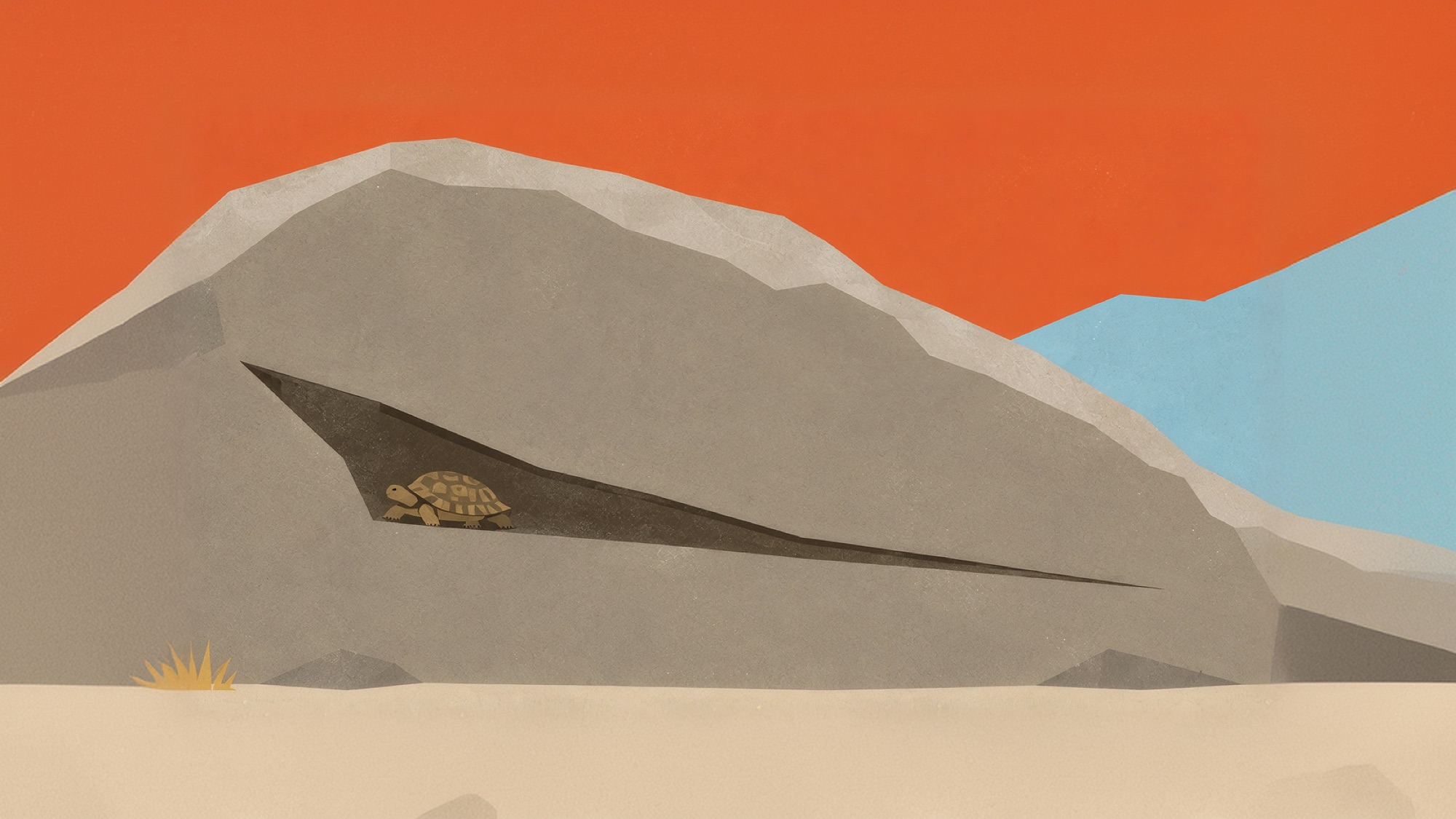
African Pancake Tortoise (Malacochersus tornieri)
The African Pancake Tortoise (Malacochersus tornieri) is a tortoise found in rocky kopjes of Kenya and Tanzania, listed Critically Endangered on the IUCN Red List.
- Common name
- African Pancake Tortoise
- Scientific name
- Malacochersus tornieri
- Conservation status (IUCN Red List)
- Critically Endangered
- Habitat
- Rocky kopjes of Kenya & Tanzania
- Edition
- TT-25: The Crack Escape
A flat, flexible tortoise that traded armor for speed: it runs into rock cracks and wedges itself tight instead of hiding in its shell. Critically Endangered.
It is Turtle Tuesday edition TT-25, “The Crack Escape”, drawn by hand and free to download.
This drawing is one of the 26 in Color the Shell, the Turtle Tuesday turtle coloring book: the same line art in black and white, with one true fact per turtle.
Every other tortoise answers danger the same way: pull in, clamp shut, become a rock, wait. The pancake tortoise threw that plan out. Its shell is thin, flat and flexible, honeycombed with holes, light enough to run in. And run it does. It lives among the rocky kopjes of Kenya, Tanzania and a corner of Zambia, and when threatened it sprints into a crack in the rock and jams itself in place. Once it’s in, you are not getting it out. That same shell is its curse: it’s Critically Endangered, prized by the pet trade for its strange flat body, and slow to recover because a female usually lays just one egg at a time.
The African pancake tortoise breaks the tortoise rulebook. Its shell is thin, flat and flexible, the bony plates honeycombed with holes, so it’s light enough to be fast. When threatened it bolts into a crack in the rock and wedges itself in tight. How it anchors there is still debated, but either way it becomes almost impossible to pull free. That same shell makes it a pet-trade prize, and with habitat loss and a slow reproductive rate, usually one egg at a time, it’s Critically Endangered.
The Tortoise That Chose Speed Over Armor
The African pancake tortoise (Malacochersus tornieri) is built backwards from most tortoises: instead of a thick shell it withdraws into, its shell is thin, flat and flexible, only about 17.8 centimeters long at most, the bone beneath honeycombed with openings. The result is an animal that’s light, low and springy.
Freed from a heavy dome, it’s a fast, agile climber on the rocky kopjes of southern Kenya, northern and eastern Tanzania, and pockets of northern Zambia.
Threatened, it runs for the nearest crack and jams itself inside. How it locks in is still argued: it may brace upward with its hind legs, or, in an older and unresolved idea, inflate its underside to wedge tight. Either way, a predator can’t pull it out.
The same features that make it extraordinary also make it a target: collectors prize its odd flat shape, and it’s been heavily taken for the pet trade on top of habitat loss. A female typically lays only one egg at a time, so populations recover painfully slowly. It’s now Critically Endangered and on CITES Appendix I.
Key Moments
- 1903: Formally described as Malacochersus tornieri; the genus name means ‘soft tortoise’, for its flexible shell
- 20th century: Its flat shell makes it a sought-after novelty in the exotic pet trade
- Ongoing: Habitat loss and collection thin populations across Kenya, Tanzania and Zambia; the single-egg clutch slows recovery
- 2019: Uplisted to CITES Appendix I, banning commercial trade in wild-caught pancake tortoises
- Present day: Assessed as Critically Endangered, its future tied to protecting rocky-outcrop habitat and stopping illegal collection
Fun Facts
- Flat On Purpose: Its shell is thin, flat and flexible, only about 17.8 centimeters long at most
- Honeycomb Bones: The bony shell is full of openings, making it light and springy instead of armored
- It Runs: Freed from a heavy dome, it’s a fast, agile climber, rare for a tortoise
- Wedges Into Rock: Threatened, it bolts into a crevice and jams itself in so tight it can’t be pulled out
- One Egg at a Time: A female usually lays just one egg per clutch. Quality over quantity
- Crevice Roommates: Several tortoises will sometimes share the same rock crevice
Conservation Notes
- The African pancake tortoise is Critically Endangered and on CITES Appendix I, collected for the pet trade for the same flat, flexible shell that makes it unique, on top of ongoing habitat loss.
- Recovery is slow by biology alone: a female usually lays only one egg at a time. Protecting the kopjes it depends on matters more here than for a fast-breeding species.
- Only about 23 percent of the pancake tortoise’s habitat sits inside protected areas, a 2013 study estimated, so protecting more rocky hills would help.
Mini FAQ
Does it really inflate itself to wedge into rocks?
Honestly, biologists aren’t sure. A threatened pancake tortoise does lock itself into a rock crevice so firmly a predator can’t pull it out. The mechanism is debated: hind legs braced against the roof, or, in an older idea, the underside inflated with air. The wedging is real; how it happens isn’t settled.
Why is its shell flat and soft instead of domed and hard?
It traded armor for agility. Most tortoises rely on a heavy shell as a bunker; this one’s shell is thin and flexible, honeycombed with openings that keep it light, letting it run and climb far faster than a normal tortoise. Safety comes from speed and disappearing into rock cracks, not sealing inside a fortress.
If it is so good at hiding, why is it Critically Endangered?
Its defenses work against predators, not people. The same flat shape that fascinates biologists makes it a prized pet-trade target. Add habitat loss and a very slow reproductive rate, usually one egg at a time, and stripped populations don’t come back quickly.
Art by Lee Eisenbarth, CC BY 4.0: how to use this art.
Sources: IUCN Red List, Wikipedia.