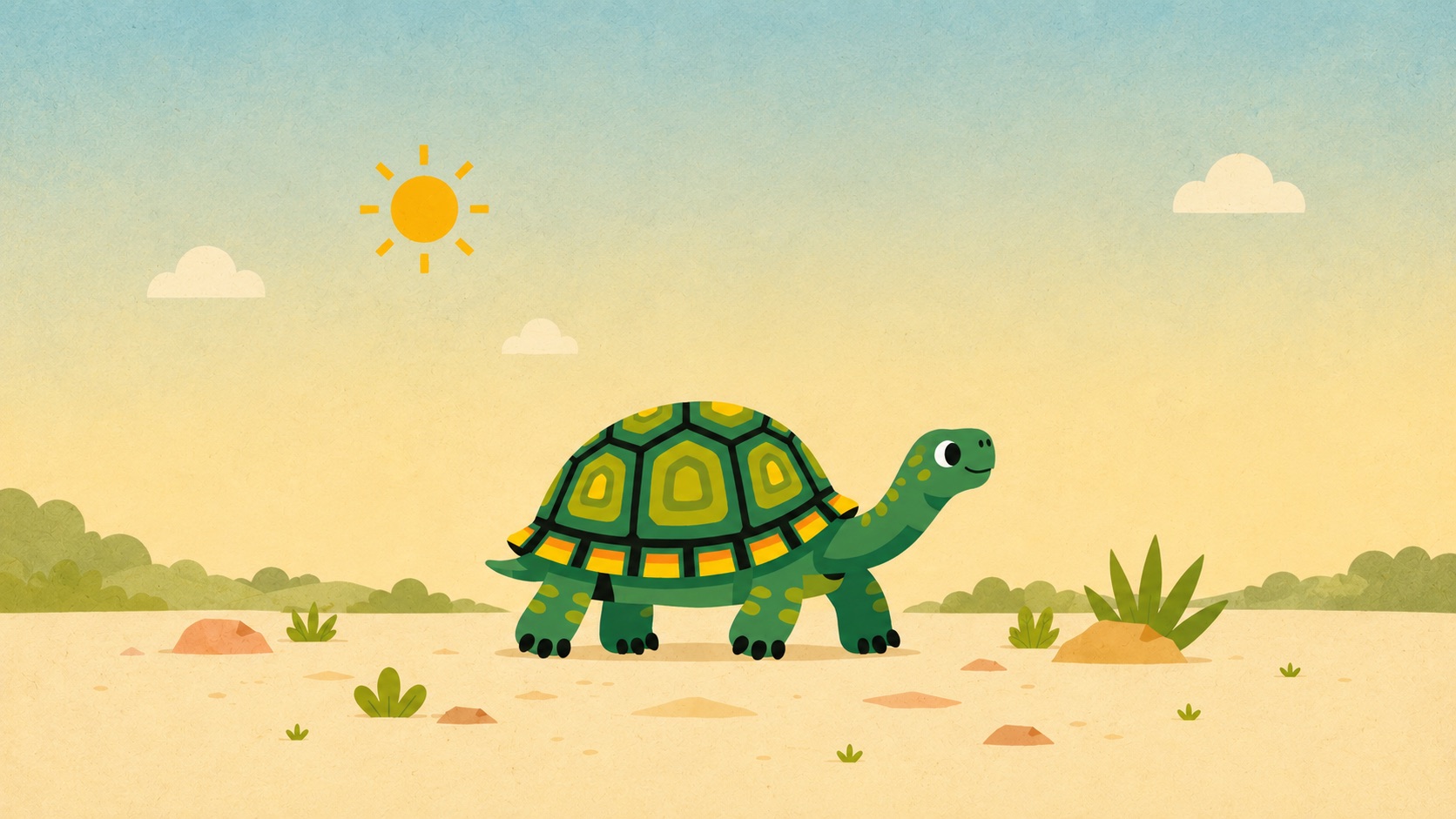
Aldabra Giant Tortoise (Aldabrachelys gigantea)
The Aldabra Giant Tortoise (Aldabrachelys gigantea) is a tortoise found in Aldabra Atoll, Seychelles, listed Vulnerable on the IUCN Red List.
- Common name
- Aldabra Giant Tortoise
- Scientific name
- Aldabrachelys gigantea
- Conservation status (IUCN Red List)
- Vulnerable
- Habitat
- Aldabra Atoll, Seychelles
- Edition
- TT-20: Island Engineer
The second-largest tortoise on Earth. They reshape their island home by grazing, creating specialized 'tortoise turf'.
It is Turtle Tuesday edition TT-20, “Island Engineer”, drawn by hand and free to download.
This drawing is one of the 26 in Color the Shell, the Turtle Tuesday turtle coloring book: the same line art in black and white, with one true fact per turtle.
Do not let the pleasant stroll fool you: this animal is doing terraforming. An Aldabra giant tortoise can push past 250 kilograms, and roughly 100,000 wander a single Indian Ocean atoll, the largest gathering of giant tortoises on Earth. Centuries of grazing produced a unique dwarf grassland botanists literally call ‘tortoise turf,’ a lawn invented by its own diners. They shove over shrubs for the leaves, dig wallows other animals use, and, despite the strictly herbivore résumé, one was filmed hunting a tern chick. Jonathan, a tortoise of this lineage on St Helena, hatched around 1832 and is still going. He is older than the light bulb. He is unbothered.
The Aldabra giant tortoise is one of two great giant tortoises left, and by numbers the most successful: about 100,000 live on Aldabra Atoll, more than all the Galápagos giants. Big males exceed 250 kilograms, with a long neck that lets them reach branches most tortoises could only resent from below. Their grazing rewrote the atoll’s botany into ‘tortoise turf,’ a dwarf plant community that flowers below jaw height. They are technically herbivores, an identity they mostly honour: one was filmed in 2020 stalking and eating a tern chick.
The Animal That Landscapes an Atoll
The Aldabra giant tortoise (Aldabrachelys gigantea) lives, in the wild, in one place: Aldabra Atoll, roughly 1,100 kilometres from the African mainland. Big males can pass 250 kilograms with a shell over a metre long, and it’s the most numerous giant tortoise on Earth: around 100,000 occupy the atoll. Remoteness is why they survive: the atoll was too dry and too sharp-edged to settle.
Their defining trick is ecological. A hundred thousand grazers cropping the same atoll for thousands of years edits the plants: what survives flowers at a height no tortoise jaw bothers with. Botanists call it ‘tortoise turf.’ The tortoise didn’t adapt to the island so much as the island adapted to the tortoise.
The engineering doesn’t stop there. Aldabra tortoises push over shrubs to reach the foliage, extending their editorial reach into the shrub layer. They carry seeds across the atoll in their guts, and dig mud wallows other animals rely on.
They’re also built for time. Aldabra giants live past a century: Jonathan, a giant tortoise of this group brought to St Helena as an adult in 1882 and thought to have hatched around 1832, is still alive. Adwaita, an Aldabra giant who lived at the Kolkata zoo, was estimated at roughly 255 years old. The IUCN lists the species as Vulnerable, since the entire wild species sits on one low-lying atoll.
Key Moments
- 1700s to 1800s: Passing ships take giant tortoises from islands across the Indian Ocean; Aldabra’s hold on because the atoll is too rugged to settle
- 1874: Charles Darwin joins a petition urging protection of Aldabra’s tortoises
- 1882: Jonathan, hatched around 1832, arrives on St Helena as an adult; he’s alive today, the oldest known living land animal
- 1982: Aldabra Atoll becomes a UNESCO World Heritage Site
- 2006: Adwaita, an Aldabra giant at the Kolkata zoo, is estimated at around 255 years old, one of the longest lives on record
- 2020: Researchers film a wild Aldabra giant tortoise hunting, the first time a giant tortoise has been seen doing it
Fun Facts
- It Invented Its Own Lawn: Centuries of grazing produced ‘tortoise turf,’ invented by the animals that eat it
- Quarter of a Tonne: Big males exceed 250 kilograms, one of the largest tortoises alive
- One Atoll, 100,000 Tortoises: Aldabra holds more giant tortoises than all the Galápagos islands combined
- Older Than the Light Bulb: Jonathan, a giant tortoise of this lineage, hatched around 1832 and is the oldest known living land animal
- Shade Crowds: On hot days they pile into the same patches of shade, sometimes dozens under one tree
- Shrub Demolition: They shove over shrubs for the leaves, keeping the atoll’s scrub from closing in
Conservation Notes
- Aldabra’s giants are the last great tortoise herd of the Indian Ocean. They held on because the atoll was too dry to settle, and naturalists, Darwin among them, campaigned for its protection as early as 1874.
- The IUCN lists the species Vulnerable despite roughly 100,000 individuals, because the wild population sits on one atoll. UNESCO protection since 1982 stands between it and a very bad day.
Mini FAQ
What actually is ‘tortoise turf’?
A plant community the tortoises built by eating. With roughly 100,000 grazers cropping the atoll for thousands of years, only plants that flower at ankle height survive. The lawn and the mower co-evolved.
How is it different from a Galápagos giant tortoise?
Separate species that reached giant size independently. The headline difference is numbers: Aldabra has around 100,000 tortoises on one atoll, more than all the Galápagos giants combined.
If there are 100,000 of them, why are they Vulnerable?
Because they all live in one spot, and that spot is a low-lying coral atoll. The population is healthy; the risk is the address. Abundance in one place isn’t the same as safety.
Art by Lee Eisenbarth, CC BY 4.0: how to use this art.
Sources: IUCN Red List, Wikipedia.