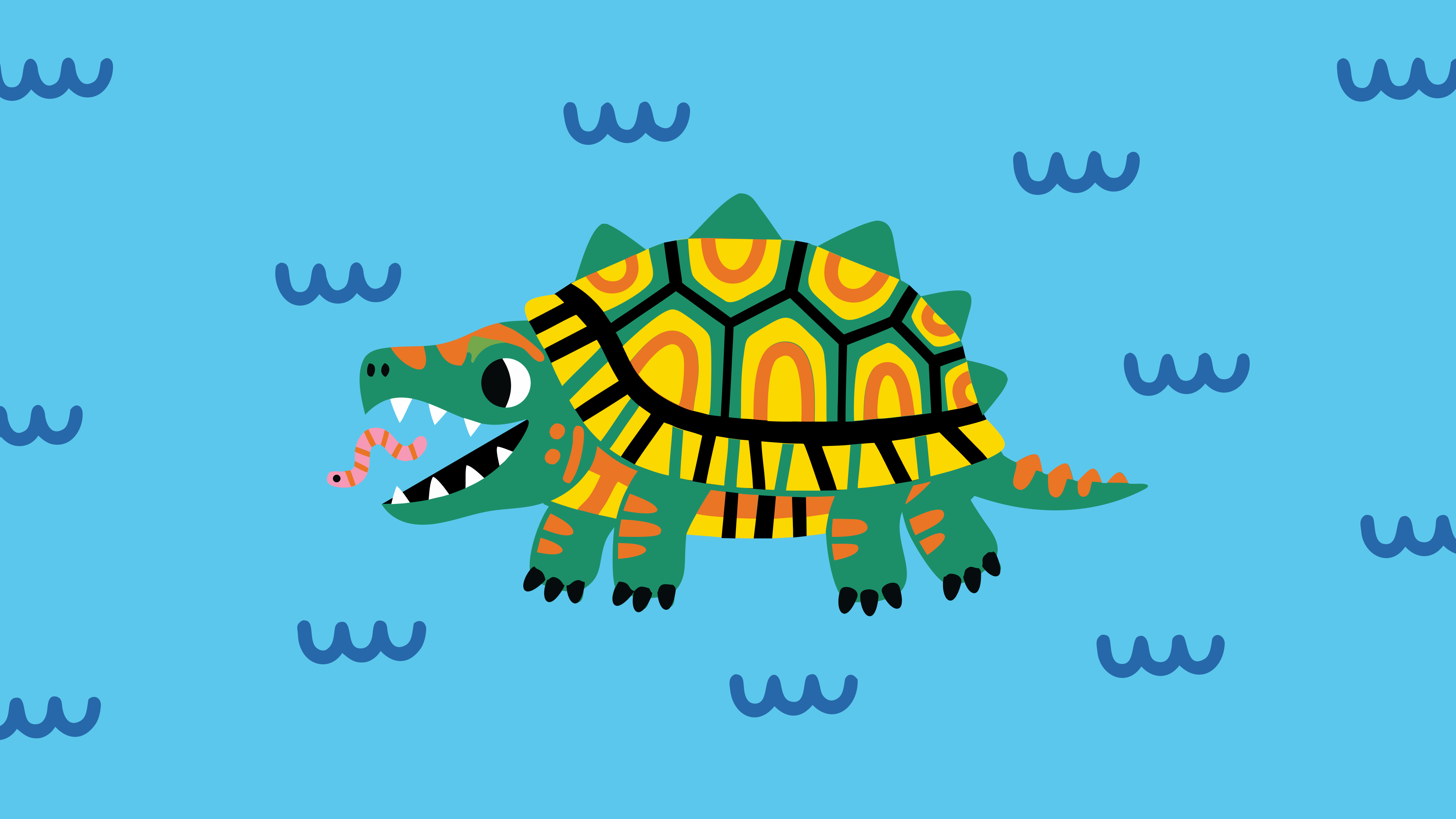
Alligator Snapping Turtle (Macrochelys temminckii)
The Alligator Snapping Turtle (Macrochelys temminckii) is a freshwater turtle found in southeastern United States rivers, listed Endangered on the IUCN Red List.
- Common name
- Alligator Snapping Turtle
- Scientific name
- Macrochelys temminckii
- Conservation status (IUCN Red List)
- Endangered
- Habitat
- Southeastern United States rivers
- Edition
- TT-15: River Monster
The largest freshwater turtle in North America. Features a bright pink, worm-shaped lure on its tongue to attract prey.
It is Turtle Tuesday edition TT-15, “River Monster”, drawn by hand and free to download.
This drawing is one of the 26 in Color the Shell, the Turtle Tuesday turtle coloring book: the same line art in black and white, with one true fact per turtle.
They don’t chase anything. They sit on the river bottom, mouth open, wiggling a bright pink, worm-shaped lure built into their tongue. Fish swim in. Snap. Over 1,000 pounds of bite force, the most powerful of any freshwater turtle on Earth. They’ve run this trick for 20 million years. North America’s largest freshwater turtle, wearing armor that looks like it came from a different era entirely. Because it did.
The alligator snapping turtle is the largest freshwater turtle in North America, up to 100 kilograms of armored, prehistoric muscle. Its tongue carries a bright pink, worm-shaped lure. They sit on the river bottom, mouth open, wiggling it, and when a fish swims in to investigate, snap. The bite force is around 1,000 pounds. They’ve run this trick for 20 million years. Absolute patience predators, and honestly, kind of genius.
20 Million Years of the Same Perfect Trick
Its most famous trait is the lingual lure on its tongue. It’s the only North American turtle that hunts this way, sitting still, mouth open, wiggling the lure. Fish, frogs, even other turtles swim in to investigate, and meet one of the strongest bites in the freshwater world, delivered with almost no effort.
The largest freshwater turtle in North America, it can exceed 100 kilograms and live past 70 years. Its shell has three ridges, or keels, giving it a prehistoric profile. It’s found throughout the southeastern U.S., from the Florida panhandle to east Texas and north into Illinois and Kansas.
It’s a genuinely modern species, distinct from the common snapping turtle, placed in its own genus, Macrochelys, first appearing in the fossil record roughly 20 million years ago. In 2014, scientists described a second living species, Macrochelys suwanniensis, from the Suwannee River.
Populations declined through the 20th century from overharvesting and river changes, until protections were put in place. The IUCN Red List now lists the species as Endangered (assessed 2023, after the Suwannee population was named a species of its own).
Key Moments
- ~20 million years ago: Macrochelys genus first appears in the fossil record, already equipped with the lure
- 1800s to 1900s: Heavy commercial harvest thins populations in many rivers
- 1975 to 1990s: Texas, Louisiana, and other states begin harvest restrictions
- 2014: Macrochelys suwanniensis described as a distinct second species from the Suwannee River
- 2025: The IUCN Red List publishes its new assessment: Endangered
Fun Facts
- Built-In Lure: The only North American turtle with a lingual lure, a pink appendage that attracts prey
- Bite Force: Over 1,000 pounds of bite force, the strongest of any freshwater turtle in North America
- Tank-Sized: Males can exceed 100 kg (220 lbs), North America’s largest freshwater turtle
- Three Keels: Three ridges, or keels, give them a spiked, prehistoric profile
- Patient Predator: Can sit motionless on the river bottom for hours; movement gives away the trick
- Named Right: Called 'alligator’ snappers for their size and skin that resembles alligator hide
Conservation Notes
- Alligator snapping turtles were heavily harvested through the mid-20th century. They live over 70 years and take 11 to 13 years to mature, so every adult matters.
- Channelization, dams, and siltation have degraded their habitat across the Mississippi drainage. They need clear water with woody cover and sandy nesting banks, both shrinking.
- From 2008 to 2010, biologists released 246 young alligator snapping turtles into Oklahoma’s Caney River and Pond Creek, and kept track of how they grew.
Mini FAQ
Is the tongue lure the only way they hunt?
No. Younger snappers and hungry adults also forage the river bottom for fish and crayfish. The lure strategy grows more common as they get bigger and slower. An ambush predator’s patience only works when you’re too large to bother moving fast.
How do they compare to common snapping turtles?
Related but distinct genera. Alligator snappers are larger and built for river-bottom ambush. Common snappers are smaller, more aggressive on land, and found east of the Rockies. Both have powerful bites. Only one has the lure.
Can they actually bite off a finger?
Technically yes, their bite exceeds 1,000 pounds. In practice bites are rare, since they’re slow-moving, deep-water animals rarely encountered on land. (Don’t grab things in murky rivers.)
Art by Lee Eisenbarth, CC BY 4.0: how to use this art.
Sources: IUCN Red List, Wikipedia.