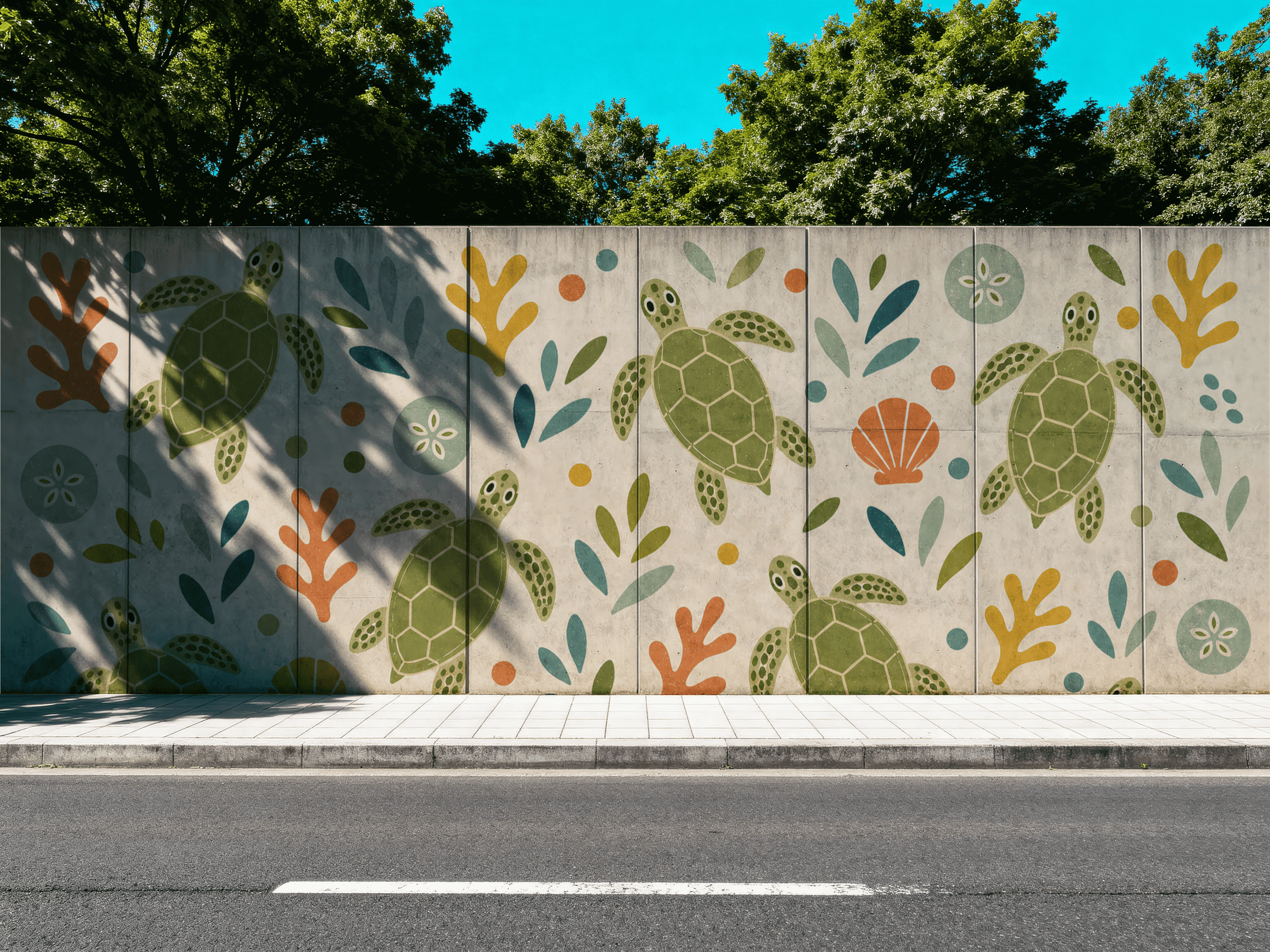
Flatback Sea Turtle (Natator depressus)
The Flatback Sea Turtle (Natator depressus) is a sea turtle found in northern Australian coastal waters, listed Data Deficient on the IUCN Red List.
- Common name
- Flatback Sea Turtle
- Scientific name
- Natator depressus
- Conservation status (IUCN Red List)
- Data Deficient
- Habitat
- Northern Australian coastal waters
- Edition
- TT-10: Coastal Zen
The homebody of sea turtles. Stays exclusively in Australian waters and doesn't leave the continental shelf.
It is Turtle Tuesday edition TT-10, “Coastal Zen”, drawn by hand and free to download.
This drawing is one of the 26 in Color the Shell, the Turtle Tuesday turtle coloring book: the same line art in black and white, with one true fact per turtle.
The only sea turtle that never leaves Australian waters. Every other species crosses entire oceans, but the flatback looked at the continental shelf and said, ‘this is fine.’ Their shell is genuinely flat with a smooth, waxy texture no other species has. They’re the least studied of all seven sea turtle species because they just don’t go anywhere people can easily follow. Introverts of the sea, completely thriving.
The flatback is the homebody of sea turtles, and I mean that in the most respectful way possible. Every other sea turtle crosses entire oceans; the flatback stays on the Australian continental shelf. It’s like it looked at the open ocean and said, ‘Nah, I’m good here, mate.’ Introverts of the sea, and totally thriving.
Australia’s Quiet Local
For over a century, flatback sea turtles were misidentified as green sea turtles. It wasn’t until 1988 that taxonomists recognized Natator depressus as its own species, the seventh and final sea turtle. A whole species, hiding in plain sight for a hundred years.
Their range is unique: every other sea turtle crosses oceans, but flatbacks stay on the Australian continental shelf, living, breeding, and nesting entirely within Australian waters.
Indigenous Australian communities have known flatbacks for thousands of years, and that ecological knowledge is now central to modern conservation.
Studying flatbacks is genuinely difficult: murky coastal waters, no predictable migration corridors, remote nesting beaches. Much of what’s known comes from indigenous ranger programs.
Key Moments
- 1880s: First specimens collected, classified as a green sea turtle variant
- 1988: Natator depressus formally recognized as its own species, the seventh sea turtle
- 2000s: Satellite tracking confirms flatbacks stay within the Australian continental shelf
- 2010s–present: Indigenous ranger programs become central to monitoring nesting beaches
Fun Facts
- Homebody: The only sea turtle that never crosses an ocean
- Flat as a Pancake: Carapace is literally flattened, with a smooth, waxy texture
- Fewer but Bigger: Lays the fewest eggs of any sea turtle, about 50 per clutch, but its eggs and hatchlings are the largest
- Shallow Diver: Stays in waters less than 60 meters deep
- No Lost Years: Unlike other sea turtles, its hatchlings skip the open ocean and grow up near the coast
- Exclusively Australian: Found nowhere else on Earth, nesting only on Australian beaches
On the Red List
- Cape Domett in Western Australia is one of the biggest flatback nesting beaches on Earth, with about 3,250 turtles nesting there a year in a 2009 study.
Mini FAQ
Why are they called flatbacks?
Their shell is noticeably flatter than other sea turtles, with a smooth, almost oily texture.
Are they really that hard to study?
Yes. Murky water, no predictable corridors, remote nesting beaches. Indigenous ranger monitoring fills the gap.
How are they different from green sea turtles?
Flatbacks are smaller, with a flatter shell and fewer but larger eggs, and they never leave Australian waters.
Art by Lee Eisenbarth, CC BY 4.0: how to use this art.
Sources: IUCN Red List, Wikipedia.