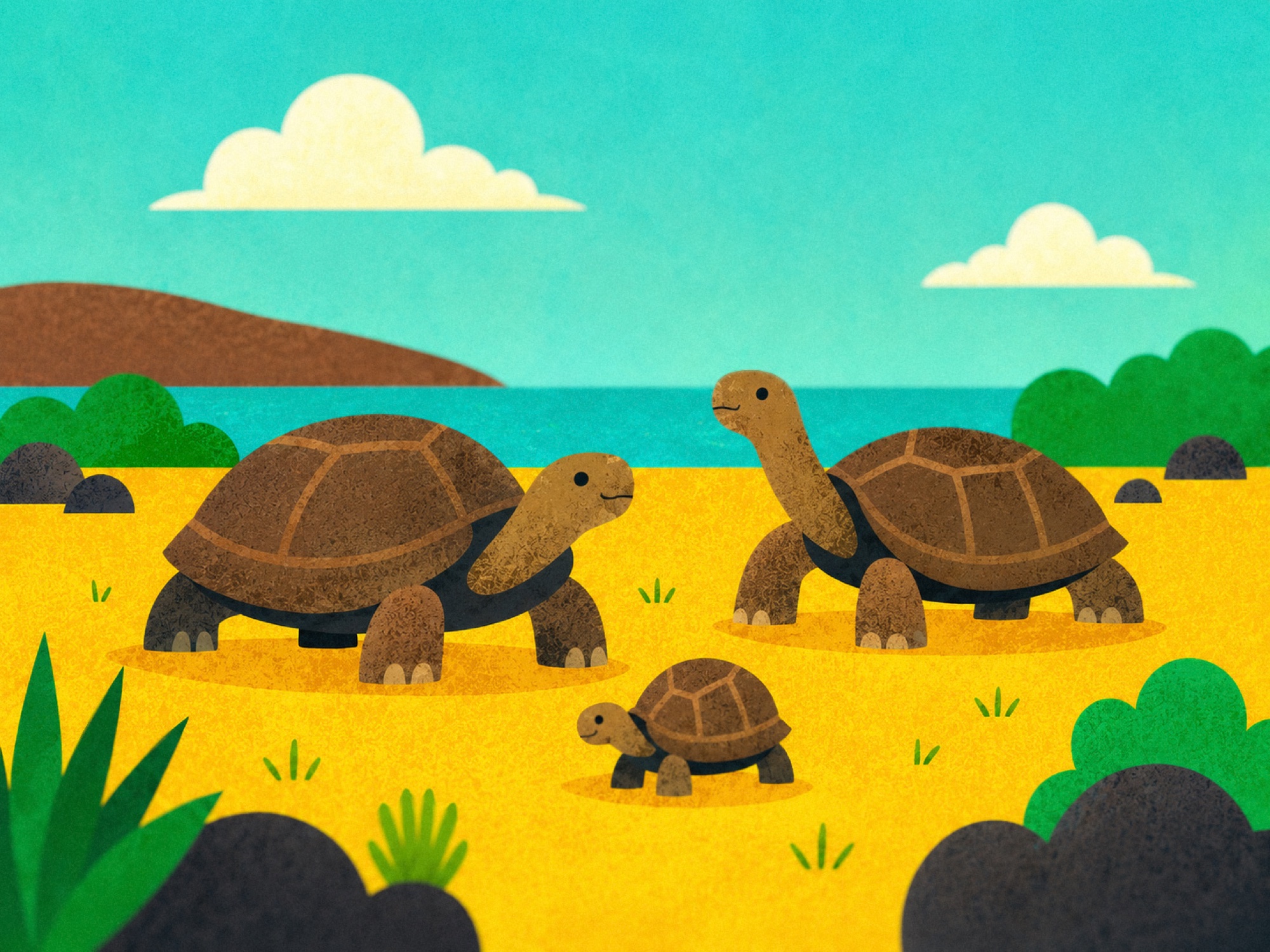
Galápagos Giant Tortoise (Chelonoidis nigra complex)
The Galápagos Giant Tortoise (Chelonoidis nigra complex) is a tortoise found in the Galápagos Islands, Ecuador, listed Vulnerable on the IUCN Red List.
- Common name
- Galápagos Giant Tortoise
- Scientific name
- Chelonoidis nigra complex
- Conservation status (IUCN Red List)
- Vulnerable
- Habitat
- Galápagos Islands, Ecuador
- Edition
- TT-14: Ancient Giant
Can live past 175 years. Their shell shapes helped Charles Darwin form the foundation of the theory of evolution.
It is Turtle Tuesday edition TT-14, “Ancient Giant”, drawn by hand and free to download.
This drawing is one of the 26 in Color the Shell, the Turtle Tuesday turtle coloring book: the same line art in black and white, with one true fact per turtle.
They can live past 175 years. The oldest confirmed individual was collected by Charles Darwin in 1835 and lived until 2006. At over 400 kg, they’re the largest tortoises on Earth, with shell shapes that helped spark the theory of evolution.
Galápagos giant tortoises can live past 175 years. The oldest confirmed individual, Harriet, was collected by Charles Darwin in 1835 and lived until 2006. They weigh up to 417 kilograms, the largest tortoises on Earth. Darwin’s observations of their varying shell shapes helped spark the theory of evolution.
The Tortoise That Changed The World
When Darwin arrived in 1835, he didn’t grasp the tortoises’ significance right away. It was the local vice-governor who pointed out he could tell which island a tortoise came from by its shell, an observation that helped form the theory of evolution.
There are two main shell shapes. Dome-shaped tortoises live on lush islands with abundant ground food. Saddleback tortoises evolved on arid islands, with raised fronts that let them stretch up to reach cactus pads.
Because they can go up to a year without food or water, 19th-century sailors carried them aboard as provisions for long voyages, and some islands lost their tortoises.
Conservation efforts, including captive breeding and invasive species removal, have brought several populations back from the brink. In 2019 a Fernandina giant tortoise, a species last seen in 1906, turned up alive.
Key Moments
- 1535: First recorded European discovery of the islands, named Galápagos after the old Spanish word for saddle
- 1835: Darwin visits aboard the HMS Beagle and observes the varying shell shapes
- 1800s to 1900s: Over 100,000 tortoises taken by whalers and pirates for food, devastating populations
- 1959: Galápagos National Park established; breeding programs begin shortly after
- 2019: A Fernandina giant tortoise, a species last seen in 1906, is found alive
Fun Facts
- Island Giants: Largest living tortoises on Earth: males can weigh over 400 kg (880 lbs) and reach 1.8 meters
- Living Fossils: Can live well past 150 years; 'Harriet’ was collected in 1835 and lived until 2006
- Saddlebacks vs Domes: Shell shape adapted to food: high for cactus, low for grass
- Built-In Canteens: Can go up to a year without food or water, storing water in their bladders and fat
- Cleaning Stations: Stretch their necks to let Darwin’s finches pick ticks off their skin
- Professional Nappers: Spend up to 16 hours a day resting to conserve energy
Conservation Notes
- Invasive goats and pigs are major threats: goats overgraze the food supply, while pigs and rats eat eggs and hatchlings.
- The Galápagos National Park Directorate and Galápagos Conservancy run a head-starting program, rearing hatchlings until large enough to survive rat predation.
- By the end of 2017, more than 7,000 young giant tortoises had been returned to the Galápagos islands they came from, Galápagos Conservancy reports.
Mini FAQ
Why are they so big?
Island gigantism. Isolated with no predators and abundant food, they evolved to massive sizes.
Can you tell their age by their shell rings?
Only when they’re young. The growth rings wear smooth with age, making an older tortoise’s exact age nearly impossible to tell.
How many species are there?
About 15 species or subspecies in the Chelonoidis nigra complex, each shaped by its own island.
Art by Lee Eisenbarth, CC BY 4.0: how to use this art.
Sources: IUCN Red List, Wikipedia.