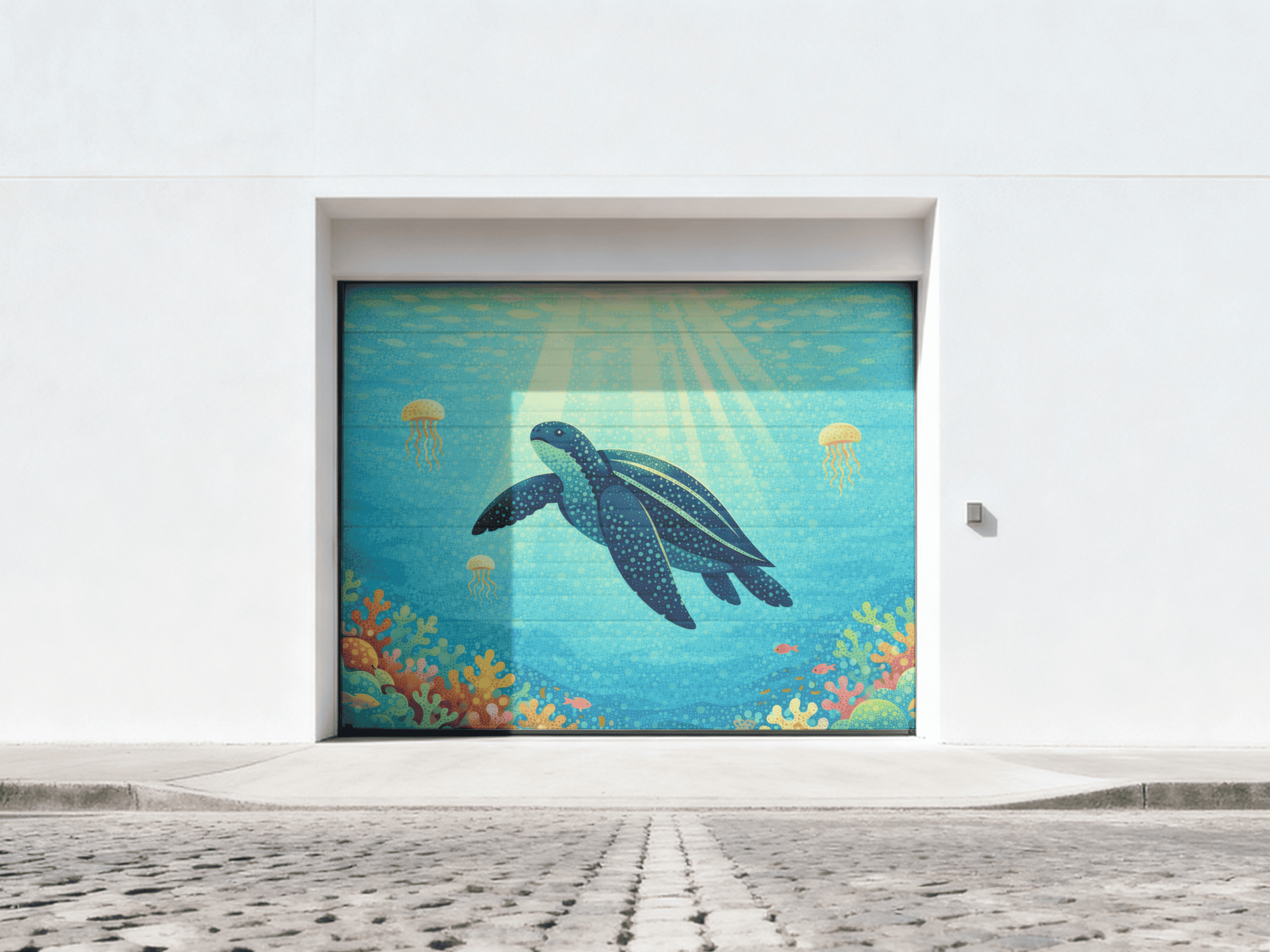
Leatherback Sea Turtle (Dermochelys coriacea)
The Leatherback Sea Turtle (Dermochelys coriacea) is a sea turtle found in open ocean, all tropical and temperate seas, listed Vulnerable on the IUCN Red List.
- Common name
- Leatherback Sea Turtle
- Scientific name
- Dermochelys coriacea
- Conservation status (IUCN Red List)
- Vulnerable
- Habitat
- Open ocean, all tropical & temperate seas
- Edition
- TT-06: Night Drifter
The largest turtle on Earth: 750 to 840 pounds on a typical nesting beach, one on record reported past 2,000. Dives deeper than the Empire State Building is tall on a single breath.
It is Turtle Tuesday edition TT-06, “Night Drifter”, drawn by hand and free to download.
This drawing is one of the 26 in Color the Shell, the Turtle Tuesday turtle coloring book: the same line art in black and white, with one true fact per turtle.
Five feet of turtle along the back, give or take. Seven hundred and fifty to 840 pounds on a typical nesting beach. One on record was reported past 2,000, a number scientists side-eye, with front flippers spanning eight feet tip to tip. No hard shell, just a leathery, ridged carapace over a body built like a submarine. Seven ridges down the back. Absolute unit doesn’t begin to cover it.
Dives deeper than the Empire State Building is tall, over 1,200 meters on a single breath. On camera, it eats close to three-quarters of its own body weight in jellyfish in a day. One was tracked 12,774 miles across the Pacific, Indonesia to Oregon. Keeps itself warm in near-freezing water, which is wildly rare for a reptile. Its family has been at this since the dinosaurs. Fishing gear is the biggest threat to every population, and a floating plastic bag looks exactly like lunch. The ocean’s most magnificent animal, undone by nets and grocery bags.
Everything below is checked against the people who tag, film and count leatherbacks, and it is stranger than the drawing. Five discoveries, then how the animal is doing and what you can do about it.
No shell. Seven ridges. Skin like a wetsuit.
Every other sea turtle wears a hard shell made of bone and covered in plates called scutes. The leatherback skipped it. Its back is a tough, rubbery skin over a mosaic of small bones and a thick layer of oily, fatty tissue, with seven ridges running nose to tail. Scientists think the loose fit lets the body squeeze under deep-sea pressure instead of cracking. [5][28]
A typical nesting female measures about 1.5 to 1.6 meters (5 feet) along the curve of her back and weighs around 340 to 380 kilograms (750 to 840 pounds), roughly four grown men. The biggest one on record, a male found on a Welsh beach in 1988, was reported at 2.56 meters (8.4 feet) over the curve, with front flippers spanning about 2.4 meters (8 feet), and about 916 kilograms (2,016 pounds). Scientists trust the length. The weight, taken on a beach in 1988, they doubt. [5][8][9][10][11]
Look at the top of the head and you will find a pale pink spot. Under it the skull is thin, right above the pineal gland, the part of the brain that reads light. The leading idea is that the spot is a skylight: as days shorten in late summer, it tells the turtle it is time to leave the feeding grounds. That is a hypothesis, and a lovely one. [29]
- Seven ridges: Keels of thickened skin, nose to tail. Hatchlings have them in white. [5]
- Leathery back: No scutes. Rubbery skin over a mosaic of small bones and oily fat. [5][28]
- The pink spot: Thin skull over the pineal gland. Thought to read day length. [29]
- Front flippers: On the 1988 giant they spanned about 2.4 meters (8 feet) tip to tip. [11]
- Spined throat: Backward-pointing spines hold slippery jellyfish while seawater is pushed out. [5][6]
- Nesting female: about 1.55 m over the curve of the back, 340 to 380 kg
- Adult man, US average, lying down: 1.75 m tall, about 90 kg
- Bathtub: 1.52 m, a standard 60-inch tub
- The 1988 giant: 2.56 m over the curve, reported 916 kg, doubted
It goes where the submarines don’t.
On 16 December 2006, a male leatherback tagged off Ireland and tracked southwest of Cape Verde dived to about 1,280 meters, or 4,199 feet. No reptile has ever been recorded deeper. Stack the Empire State Building on itself three times and the turtle would still be below the top. [13][14]
Those dives are rare. Of 26,146 dives logged from 13 turtles, 99.6 percent stayed shallower than 300 meters. Most are under 200 meters and under 40 minutes. The deep ones tend to happen around midday and last over an hour, and the best explanation is that the turtle is scanning the dark water column for jellyfish that sink during the day. The longest breath-holds run toward 85 to 90 minutes. [5][6][15][16]
Scientists think a rigid shell would not take that pressure. The leatherback’s loosely interlocking bones and flexible back are thought to absorb the squeeze on the way down and the release on the way up. [5]
- 30 m, Most meals: On a Nova Scotia feeding ground, jellyfish were taken in the sunlit water above about 30 meters. [17]
- 200 m, A normal dive: Most dives stay above 200 meters and under 40 minutes. [16]
- 300 m, The 99.6 percent line: Of 26,146 recorded dives, only 95 went deeper than this. [15]
- 443 m, Empire State Building: 443 meters to the tip of the antenna.
- 626 m, The 2002 record: A 54-minute dive to 626 meters was the deepest known at the time. [16]
- 828 m, Burj Khalifa: 828 meters, the tallest building on Earth.
- 1,280 m, The record: About 1,280 meters, 16 December 2006, southwest of Cape Verde. The deepest dive recorded for any reptile. [13][14]
A warm animal in freezing water.
Reptiles are supposed to be as warm as their surroundings. Leatherbacks are not. One pulled from cold water in 1972 had a core temperature 18 degrees Celsius above the sea. Field measurements in sub-polar water show gaps of at least 8 degrees, and up to 4 degrees in the tropics. [19][21]
The trick has a name, gigantothermy. A huge body loses heat slowly. A thick layer of oily, fatty tissue holds it in. And at the base of each flipper, warm blood heading out runs beside cold blood coming back, so the heat is handed off before it reaches the sea. [5][18]
The result is the widest range of any reptile on Earth: a leatherback has been caught at 71 degrees north off Norway and seen at 47 degrees south off New Zealand. One was watched swimming hard in Newfoundland water at about 0 degrees Celsius, and nineteen have been reported in the Gulf of Alaska. [5][20][22]
- Newfoundland, March: water about 0 °C, turtle swimming, alive. Trinity Bay, 1984. [20]
- Sub-polar feeding grounds: water cold, turtle at least 8 °C warmer. Adult field measurements. [21]
- The tropics: water warm, turtle up to 4 °C warmer. Adult field measurements. [21]
- One animal, 1972: water cold, turtle 18 °C warmer. A single measured turtle; a model puts the ceiling near 18 °C for a 300 kg adult. [19][21]
The 12,774‑mile commute.
A female tagged on a nesting beach at Jamursba-Medi, in Papua Barat, Indonesia, was tracked 20,558 kilometers, or 12,774 miles, over 647 days to a feeding ground off Oregon. It is among the longest journeys ever recorded for a marine animal. [24]
That is not a round trip, and it is not a straight line. Satellite tags on 126 western Pacific leatherbacks showed the crossing to the California Current takes 10 to 12 months, and many turtles then spend years moving between summer feeding in the north and winter in the tropics without going home at all. [25]
When a female does go home, she returns to the same stretch of ocean and coast she hatched on, but not necessarily the same beach. Both sexes come back to those waters to mate. The map’s dots are the big nesting beaches, the feeding grounds in this story, and the far edges of the record: Grande Riviere in Trinidad with more than 5,000 nesting females, Gabon with about 8,500, Playa Grande in Costa Rica, the Huon Coast of Papua New Guinea, Cape Breton, Norway, New Zealand and the Gulf of Alaska. [5][22][23][30]
- Jamursba-Medi, Papua Barat: Where the tracked female was tagged. The Bird’s Head coast holds about three-quarters of western Pacific nesting. [30]
- Off Oregon: The end of the 647-day track. The California Current is a summer feeding ground. [24][25]
- Grande Riviere, Trinidad: More than 5,000 nesting females, the largest site in the Northwest Atlantic. [5]
- French Guiana and Suriname: Big Atlantic beaches where few eggs make it: 33 to 39 percent hatch in French Guiana. [5]
- Gabon: About 8,500 nesting females, most of the Southeast Atlantic. [5]
- Playa Grande, Costa Rica: The eastern Pacific stronghold. Egg poaching fell from over 90 percent to near zero after the park was protected. [5]
- Huon Coast, Papua New Guinea: An estimated 300 to 500 females a year, not consistently counted. [5]
- Off Cape Breton, Nova Scotia: Where the jellyfish cameras were worn. [23]
- Off Norway, 71° N: The northernmost leatherback on record, caught at sea. [5]
- Off New Zealand, 47° S: The southern edge of the range. [5]
- Gulf of Alaska: Nineteen leatherbacks reported in Alaska waters, 1963 to 1993. [22]
Three hundred kilos of jellyfish. Give or take.
Leatherbacks eat jellyfish and their soft relatives, at every age. Off Cape Breton, Nova Scotia, researchers strapped small cameras to 19 of them. From about two hours of video per turtle, scaled up to a day, the turtles were taking around 261 lion’s mane jellyfish, some 330 kilograms (730 pounds) of jelly, close to three-quarters of their own body weight. One turtle’s rate worked out to 840 kilograms. [23]
Jellyfish are mostly water, which is why the numbers are so large. A different study worked the other way, from the energy an adult needs, and put the daily requirement at 65 to 117 kilograms. Both can be true: one is what the cameras saw on a rich feeding ground, scaled up; the other is a modelled requirement. Over a lifetime that adds up to roughly a thousand tonnes of jellyfish per turtle. [23][26]
The mouth is built for it. Sharp cusps on the jaw grab the prey, and the throat is lined with backward-pointing spines that hold the slippery meal in place while the turtle pushes the seawater back out. A floating plastic bag looks and moves a lot like a jellyfish, which is the heart of the species’ most modern problem. In 408 leatherbacks examined after death between 1885 and 2007, plastic was found in the gut of 34 percent. [5][27]
- 261 lion’s mane jellyfish: one turtle, one day, as the cameras scaled it
- Seen on camera, scaled to a day: 330 kg (Nova Scotia, average of 19 turtles [23])
- Modelled need, upper figure: 117 kg (Energy an adult needs [26])
- Modelled need, lower figure: 65 kg (Energy an adult needs [26])
- The turtle itself: 455 kg (Body mass assumed in the camera study [23])
An ordinary life, if you can call it that
- Nesting
- At night, on a tropical or subtropical beach. About 80 to 100 eggs a clutch (the range is 20 to 100), five to seven clutches a season, then two to four years off. [5][6]
- Hatching
- About two months in the sand. Warmer sand makes more females; the halfway point is around 29 to 30 degrees Celsius, and above 32 the eggs are unlikely to survive. Hatchlings are about 6 centimeters long. [5]
- Growing up
- Nobody is sure how long it takes. Estimates run from about 5 years in fast captive growth to a median of 24 to 29 years from bone rings in wild Atlantic turtles. [21][31]
- How long they live
- Unknown. Nobody has followed one from hatchling to old age. Guesses run from a few decades to about 90 years, and none of them is a measurement. [32]
- The family tree
- The leatherback’s family has a fossil record that reaches the Late Cretaceous, more than 66 million years ago, though the oldest certain members are much younger and the exact age is still argued. The wider sea-turtle line is older than 100 million years. [33][34][35]
How it is doing, honestly
The one-word status on this page says Vulnerable. That is the global figure, assessed in 2013, and it hides a split. The Atlantic still counts its nesting females in the tens of thousands; the Pacific has lost most of its nesting turtles in a single generation. [1][2][5][6]
- Worldwide (IUCN Red List): Vulnerable (2013). The species as a whole. [1][2]
- East Pacific: Critically Endangered (2013). Nesting down more than 97 percent. [1][6]
- West Pacific: Critically Endangered (2013). Nesting down more than 80 percent; the main beach fell 78 percent from 1984 to 2011. [1][6][30]
- Northwest Atlantic: Endangered (2019). Reassessed from Least Concern after about a 60 percent drop in nests. [3]
- Southwest Indian Ocean: Critically Endangered (2013). About 148 adults. [4]
- United States (Endangered Species Act): Endangered (since 1970). A 2020 status review found all seven populations at high risk. [5][6][7]
What is pushing on it
- Fishing gear. Longlines, gillnets and trawls catch leatherbacks by accident, and a turtle that cannot surface drowns. It is the biggest threat to every population. [5]
- Plastic. Bags, balloons and fishing line look like food, so every piece kept out of the ocean helps. [27]
- Eggs. Taking eggs from nests emptied beaches in the past and still happens in places. [5]
- Lights and lost beaches. Bright shorelines turn females away and send hatchlings the wrong way. Development and rising seas take the sand itself. [5]
- Boats. Along the US coast, 204 of 957 stranded leatherbacks in ten years had probable propeller or hull injuries. [5]
- Heat. Warmer sand means more females and, above 32 degrees Celsius, eggs that are unlikely to survive. [5]
What has worked
- Turtle excluder devices, required on US shrimp trawls since 1987, let 97 percent of turtles escape the net when they are installed and kept properly. [36]
- Circle hooks on US longlines, used since 2004, cut the chance of catching a leatherback two to three times compared with the old J hooks. [37]
- At Playa Grande in Costa Rica, egg poaching went from more than 90 percent in the 1970s to almost none by 1994 once the beach became a park. [5]
What you can do
- Skip the bag and the balloon. To a leatherback, both look like lunch.
- If you live or stay near a nesting beach, keep lights off the sand from May to October. Turtle-friendly lighting, Sea Turtle Conservancy
- Buy shrimp from boats that use turtle excluder devices (US wild-caught is covered by law) and check wild fish against Seafood Watch. Seafood Watch
- Support the people who work on leatherbacks every day. Sea Turtle Conservancy
- In the eastern Pacific, where the decline is steepest, one group works on nothing else. The Leatherback Trust
- The Caribbean network counts the Atlantic beaches behind the 2019 assessment. WIDECAST
- Found one on a US beach, alive or not? Don’t touch or push it. Call the NOAA stranding line for your coast; in the Southeast it is (844) SEA-TRTL. NOAA, report a stranded animal
Key Moments
- Late Cretaceous: The leatherback’s family appears in the fossil record, more than 66 million years ago
- 1970: Listed as Endangered under the US Endangered Species Act, where it remains
- 1988: The largest leatherback on record washes ashore at Harlech, Wales: 2.56 meters over the shell, a reported 916 kilograms
- 2006: A tagged male dives to about 1,280 meters off Cape Verde, the deepest dive recorded for any reptile
- 2008: A female’s 20,558-kilometer track from Indonesia to Oregon is published, among the longest ever recorded for a marine animal
- 2019: The Northwest Atlantic population is reassessed from Least Concern to Endangered
- 2020: A US status review finds all seven leatherback populations need protection
Fun Facts
- Deep Diver: Recorded to about 1,280 meters, deeper than any other reptile
- Jellyfish Vacuum: On camera off Nova Scotia, about 330 kilograms of jellyfish a day, close to three-quarters of its body weight
- Warm-Blooded-ish: Keeps its body well above the water temperature, 18 degrees Celsius in one measured turtle
- Marathon Migrant: One female was tracked 12,774 miles from Indonesia to Oregon over 647 days
- Record Holder: Largest on record: reported at 2,016 pounds, found at Harlech, Wales, in 1988
- Spiky Throat: Its throat is lined with backward-pointing spines that keep slippery jellyfish moving one way
Mini FAQ
Why no hard shell?
Its back is leathery skin over a mosaic of small bones and a thick oily layer. Scientists think the loose, flexible build takes deep-sea pressure without cracking.
How do they eat so many jellyfish?
Backward-pointing spines in the mouth and throat hold the slippery prey while the turtle pushes the seawater back out.
Are they actually warm-blooded?
Not in the mammal sense. Gigantothermy: a huge body, a thick fatty layer and heat exchangers at the base of the flippers keep the core well above the water, by 8 degrees Celsius or more in cold seas.
Do leatherbacks mistake plastic for jellyfish?
Sometimes. A floating bag looks a lot like a jellyfish, so every bag kept out of the ocean helps.
Is the leatherback endangered?
Worldwide it is listed as Vulnerable (2013), but the Pacific populations are Critically Endangered and the Northwest Atlantic was moved to Endangered in 2019. In the United States it has been Endangered since 1970.
Art by Lee Eisenbarth, CC BY 4.0: how to use this art.
Sources: IUCN Red List, Wikipedia.
Last checked 2026-10-06. Numbered sources for the story above:
- IUCN Red List, Dermochelys coriacea (Wallace, Tiwari and Girondot, 2013)
- GBIF, IUCN category for Dermochelys coriacea
- Northwest Atlantic Leatherback Working Group (2019), IUCN Red List assessment of the Northwest Atlantic subpopulation
- Indian Ocean Turtle Newsletter, summary of the leatherback Red List assessments in the Indian Ocean
- NMFS and USFWS (2020), Endangered Species Act status review of the leatherback turtle
- NOAA Fisheries, leatherback turtle species page
- USFWS and NMFS (2020), 12-month finding on the Northwest Atlantic leatherback petition, 85 FR 48332
- Georges and Fossette (2006), Estimating body mass in leatherback turtles, Marine Ecology Progress Series 318
- South Carolina Department of Natural Resources, leatherback sea turtle species account (2015; no longer online)
- McClain et al. (2015), Sizing ocean giants, PeerJ 3:e715
- Eckert and Luginbuhl (1988), Death of a giant, Marine Turtle Newsletter 43
- This Old House, standard bathtub sizes (60 by 30 inches)
- Doyle et al. (2008), Leatherback turtles satellite-tagged in European waters, Endangered Species Research 4
- Guinness World Records, deepest dive by a chelonian
- Houghton et al. (2008), The role of infrequent and extraordinary deep dives in leatherback turtles, Journal of Experimental Biology 211
- Hays et al. (2004), First records of oceanic dive profiles for leatherback turtles, Animal Behaviour 67
- Wallace et al. (2015), Fine-scale foraging ecology of leatherback turtles, Frontiers in Ecology and Evolution 3
- Paladino, O’Connor and Spotila (1990), Metabolism of leatherback turtles, gigantothermy, and thermoregulation of dinosaurs, Nature 344
- Frair, Ackman and Mrosovsky (1972), Body temperature of Dermochelys coriacea: warm turtle from cold water, Science 177
- COSEWIC, leatherback turtle status report, chapter 6
- Bostrom (2009), Thermoregulation in the leatherback sea turtle, and Jones (2009), Energetics of the leatherback turtle, University of British Columbia theses
- NOAA Fisheries, Sea turtles in Alaska
- Heaslip et al. (2012), Jellyfish support high energy intake of leatherback sea turtles, PLoS ONE 7(3)
- Dutton, Benson and Hitipeuw (2008), Pacific leatherback sets long-distance record, SWOT Report 3
- Benson et al. (2011), Large-scale movements and high-use areas of western Pacific leatherback turtles, Ecosphere 2(7)
- Jones et al. (2012), Resource requirements of the Pacific leatherback turtle population, PLoS ONE 7(10)
- Mrosovsky, Ryan and James (2009), Leatherback turtles: the menace of plastic, Marine Pollution Bulletin 58
- Gentry et al. (2025), A new leatherback marine turtle from the lower Oligocene of North America, Palaeodiversity 18
- Davenport, Jones, Work and Balazs (2014), Pink spot, white spot: the pineal skylight of the leatherback turtle, Journal of Experimental Marine Biology and Ecology
- Tapilatu et al. (2013), Long-term decline of the western Pacific leatherback, Ecosphere 4(1)
- Avens et al. (2009), Skeletochronological age estimates for leatherbacks in the western North Atlantic, Endangered Species Research 8
- Wikipedia, Leatherback sea turtle, as a pointer to the lifespan estimates and their sources
- Wikipedia, Dermochelyidae, as a pointer to the fossil record and its sources
- The shell bone histology of fossil and extant marine turtles revisited (2014), Biological Journal of the Linnean Society 112
- Liaw and Tsai (2026), The first fossil of the extant leatherback sea turtle, Acta Palaeontologica Polonica 71
- NOAA Fisheries, turtle excluder devices
- Swimmer et al. (2017), Sea turtle bycatch mitigation in US longline fisheries, Frontiers in Marine Science 4
- US CDC, National Center for Health Statistics, body measurements (average adult height and weight)