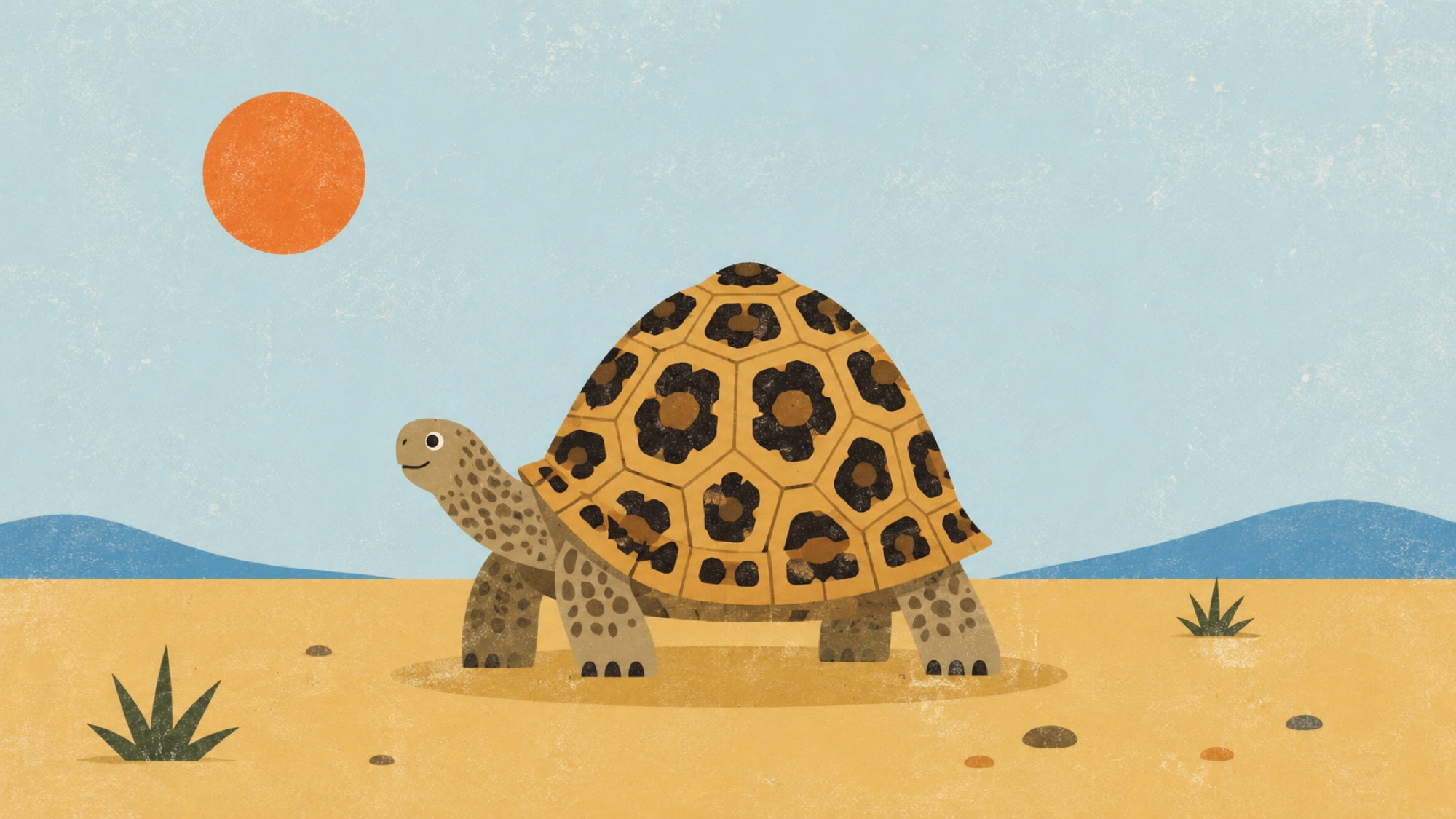
Leopard Tortoise (Stigmochelys pardalis)
The Leopard Tortoise (Stigmochelys pardalis) is a tortoise found in savannas of eastern and southern Africa, listed Least Concern on the IUCN Red List.
- Common name
- Leopard Tortoise
- Scientific name
- Stigmochelys pardalis
- Conservation status (IUCN Red List)
- Least Concern
- Habitat
- Savannas of eastern & southern Africa
- Edition
- TT-23: The Sun Grazer
The fourth-largest tortoise on Earth: a gentle savanna grazer in a leopard's coat, built for African heat and drought.
It is Turtle Tuesday edition TT-23, “The Sun Grazer”, drawn by hand and free to download.
This drawing is one of the 26 in Color the Shell, the Turtle Tuesday turtle coloring book: the same line art in black and white, with one true fact per turtle.
The spots are a bluff. Everything about the shell says big cat, tawny gold blotched with dark rosettes like a leopard mid-stalk, and everything about the animal underneath says the opposite: a slow, mild, entirely vegetarian lawnmower that would like to be left alone with a patch of grass. This is the fourth-largest tortoise on Earth, a giant of the African savanna that can push past 40 kilograms and live most of a century. He pulls most of his water straight from plants and can go long stretches without drinking, which is exactly what you want when your address is open country from Sudan down to the Cape. In tall, sun-dappled grassland those blotches break up the outline of a very large, very edible reptile until he’s just another patch of shade. He is not fast. He has never needed to be.
The leopard tortoise is the fourth-largest tortoise species on Earth, the giant of the African savanna. Typical adults reach around 40 centimeters and 13 kilograms, but the biggest push past 70 centimeters and 40 kilograms, and they can live 80 to 100 years. The tawny shell, blotched with dark rosettes, genuinely resembles a leopard’s coat, camouflage rather than warning in dappled grassland. They’re pure grazers, drawing most of their water from what they eat and ranging from Sudan down to the Cape. The IUCN lists them Least Concern.
A Gentle Giant in a Predator’s Coat
The leopard tortoise (Stigmochelys pardalis) is the fourth-largest tortoise in the world and the largest across most of its African range. Typical adults reach about 40 centimeters and 13 kilograms; exceptional ones climb past 70 centimeters and 40 kilograms, and a healthy one can live 80 to 100 years. The shell is tall and steeply domed, tawny gold blotched with dark brown and black, and the markings are crispest on the young, which is where the leopard name comes from.
The pattern looks like a threat and functions as the opposite. This is a committed vegetarian, grazing forbs, thistles, grasses and succulents, and the dark rosettes on gold are camouflage. In tall, sun-dappled savanna grass, they break up the outline of a large, slow, entirely edible reptile until it reads as just another patch of light and shadow. Being invisible is its whole security strategy, because running certainly is not.
Its range is one of the widest of any tortoise: savanna and dry grassland from Sudan down to the southern Cape. The domed shell is as much a climate adaptation as a defense.
For all that dry-land specialization, they carry one surprising talent. Most tortoises are poor swimmers, but the leopard tortoise is one of the few reported to swim readily and even stay submerged for several minutes, kept afloat by its domed shell. It isn’t an aquatic animal, but unlike most of its relatives it isn’t helpless in water.
Key Moments
- 1830s: The species is described in the scientific literature; it’s later placed in its own genus, Stigmochelys
- Across its range: Leopard tortoises spread across one of the widest ranges of any tortoise, from Sudan south to the Cape
- Adulthood: Reaching the fourth-largest size of any tortoise, past 40 kilograms, with a lifespan of 80 to 100 years
- Modern era: Regulated under CITES Appendix II as pet trade demand grows for the marked juveniles
- Present day: Assessed as Least Concern by the IUCN, the most secure status of any species featured so far
Fun Facts
- Named for a Cat: The tawny shell is blotched with dark rosettes like a leopard’s coat, crispest on the young
- Fourth-Largest Tortoise: It’s the fourth-largest tortoise species on Earth, and the biggest across most of its African range
- Drinks Its Dinner: It pulls most of its water from the plants it grazes and can go long stretches without a drink
- The Tortoise That Swims: Unusually for a tortoise, it’s reported to swim and stay submerged for several minutes
- Pure Grazer: A committed vegetarian working through forbs, thistles, grasses and succulents across the savanna
- Most of a Century: A healthy leopard tortoise can live 80 to 100 years
Conservation Notes
- The leopard tortoise is assessed Least Concern by the IUCN, the healthiest status of any species featured here so far: widespread and not threatened at the species level.
- That’s not a reason to relax. It’s held on CITES Appendix II because of steady pet trade demand, and local populations can still be worn down even while the range-wide picture stays stable.
- In good habitat it can be common: a 2000 study in South Africa’s Eastern Cape thicket found about 0.85 leopard tortoises per hectare.
Mini FAQ
Why is it called a leopard tortoise if it just eats grass?
Purely for the shell. The tawny gold carapace is blotched with dark rosettes that really do resemble a leopard’s coat, sharpest on young animals. There’s nothing predatory about the tortoise itself; the pattern is camouflage.
Can a leopard tortoise really swim?
Mostly true, and genuinely unusual. Most tortoises are poor swimmers, but the leopard tortoise is one of the few reported to swim readily and stay under for several minutes, helped by its shell’s buoyancy. Day to day, though, it keeps its feet on dry ground.
If it is Least Concern, does it still need protecting?
It’s the most secure species we’ve featured so far. But Least Concern describes the whole range, not any one place. It’s still collected for the pet trade, especially marked juveniles, which is why it’s held on CITES Appendix II.
Art by Lee Eisenbarth, CC BY 4.0: how to use this art.
Sources: IUCN Red List, Wikipedia.