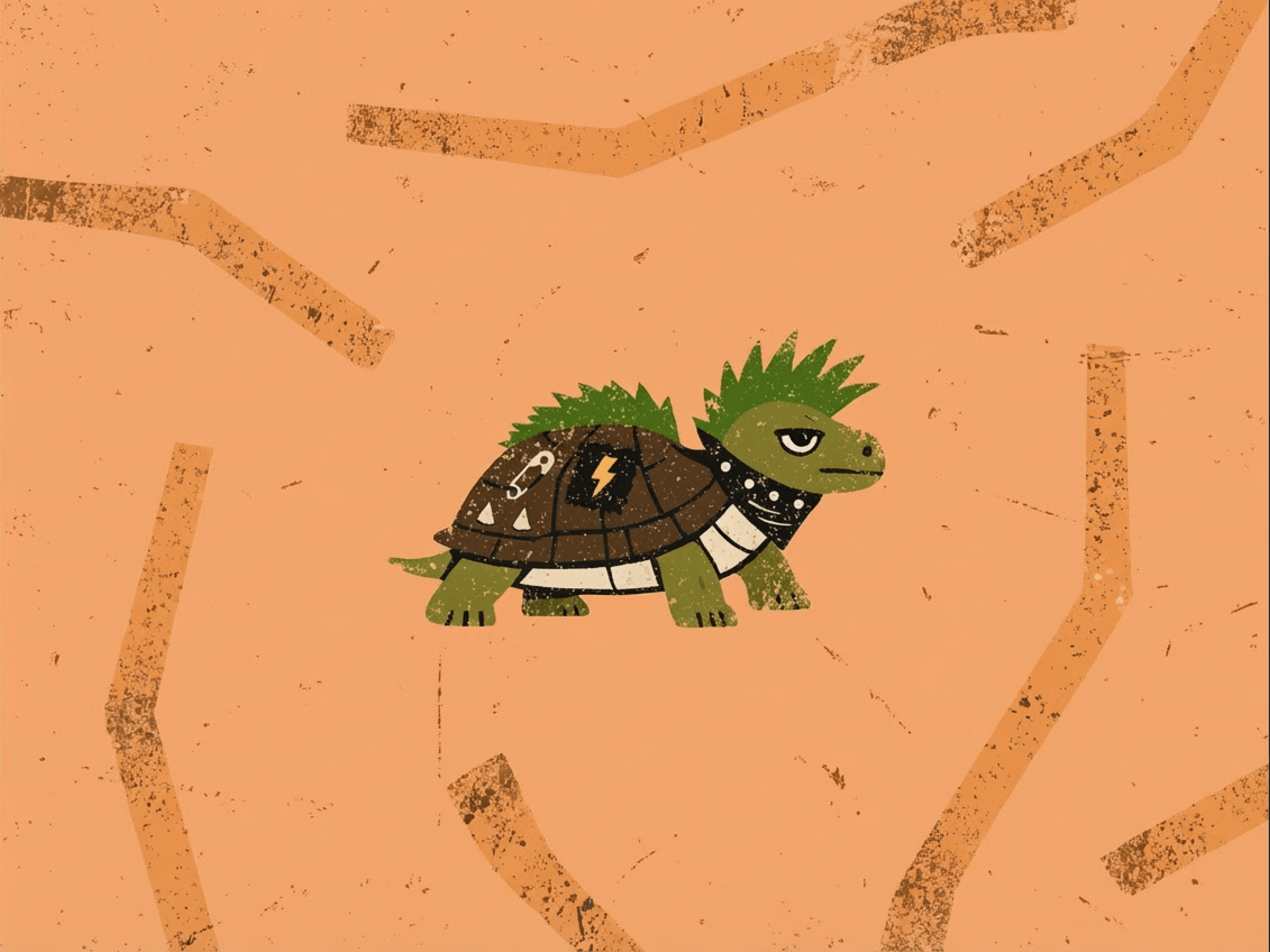
Mary River Turtle (Elusor macrurus)
The Mary River Turtle (Elusor macrurus) is a freshwater turtle found in the Mary River, Queensland, Australia, listed Endangered on the IUCN Red List.
- Common name
- Mary River Turtle
- Scientific name
- Elusor macrurus
- Conservation status (IUCN Red List)
- Endangered
- Habitat
- Mary River, Queensland, Australia
- Edition
- TT-05: Punk Rocker
Grows a green algae mohawk and breathes through specialized glands in its cloaca (butt), allowing it to stay submerged for 72 hours.
It is Turtle Tuesday edition TT-05, “Punk Rocker”, drawn by hand and free to download.
This drawing is one of the 26 in Color the Shell, the Turtle Tuesday turtle coloring book: the same line art in black and white, with one true fact per turtle.
Green algae mohawk. Pale blue eyes. A tail two-thirds the length of its shell. Fastest swimmer in its river. Looks like it should be headlining a punk show at a dive bar in Brisbane. This is not a metaphor. This turtle genuinely looks like it has an opinion about your music taste.
Takes 30 years to reach adulthood, one of the slowest maturing reptiles alive. For decades, Australian pet shops sold them as 'penny turtles’ with no idea they were an undescribed species. Science didn’t formally identify them until 1994. They breathe through specialized glands in their cloaca (yes, their butt), letting them stay submerged for up to 72 hours. One species, one river, 40 million years of doing things differently.
The Turtle Science Forgot
For decades, Australian pet shops sold thousands of Mary River turtle hatchlings as ‘penny turtles,’ cheap, cute, and totally unidentified.
It wasn’t until 1994 that herpetologist John Cann formally described the species. He had first found the mystery hatchlings in the 1960s and spent decades tracing them to a single river system in south-eastern Queensland. The Mary River turtle was hiding in plain sight the entire time.
Genetic analysis placed Elusor macrurus on its own evolutionary branch, a lineage that diverged roughly 40 million years ago, with no close living relatives. The Zoological Society of London ranks it among the most Evolutionarily Distinct and Globally Endangered (EDGE) reptiles on the planet.
The pet trade made them famous and then put them in danger. Hatchling collecting, dams and habitat loss pushed the species to endangered status, and conservation breeding is now underway.
Key Moments
- 1960s: John Cann encounters unidentified hatchlings in the pet trade, begins a decades-long search
- 1960s to 1970s: Tens of thousands sold as ‘penny turtles,’ species still undescribed
- 1994: Cann and John Legler formally describe Elusor macrurus
- 2018: ZSL ranks the Mary River turtle #29 on the EDGE reptile list
- 2020s: Conservation breeding and river restoration ramp up in Queensland
Fun Facts
- Butt Breathing: Absorbs oxygen through cloacal bursae, gill-like structures in its rear end
- Algae Mohawk: Algae grows on its head and shell; some get full green mohawks
- Blue-Eyed Beauty: Pale, striking blue eyes, unusual among freshwater turtles
- 30-Year Puberty: Doesn’t reach sexual maturity until roughly age 25 to 30. That’s longer than most humans take.
- Speed Demon: Fastest swimming turtle in the Mary River
- One of a Kind: No close living relatives, 40 million years of solo evolution
On the Red List
- The Mary River turtle lives in one Queensland river system and nowhere else, a range about 290 kilometers long, says Australia’s 2024 conservation advice.
Mini FAQ
How does butt-breathing actually work?
Sac-like structures called cloacal bursae extract dissolved oxygen as the turtle pumps water in and out, essentially using its rear end as a gill.
Why did it take until 1994 to identify?
The hatchlings were so common in pet shops nobody thought to ask what they were.
Is the mohawk intentional?
Not exactly. Sitting motionless underwater for days lets algae colonize its shell and head. It doubles as camouflage: their own ghillie suit.
Art by Lee Eisenbarth, CC BY 4.0: how to use this art.
Sources: IUCN Red List, Wikipedia.