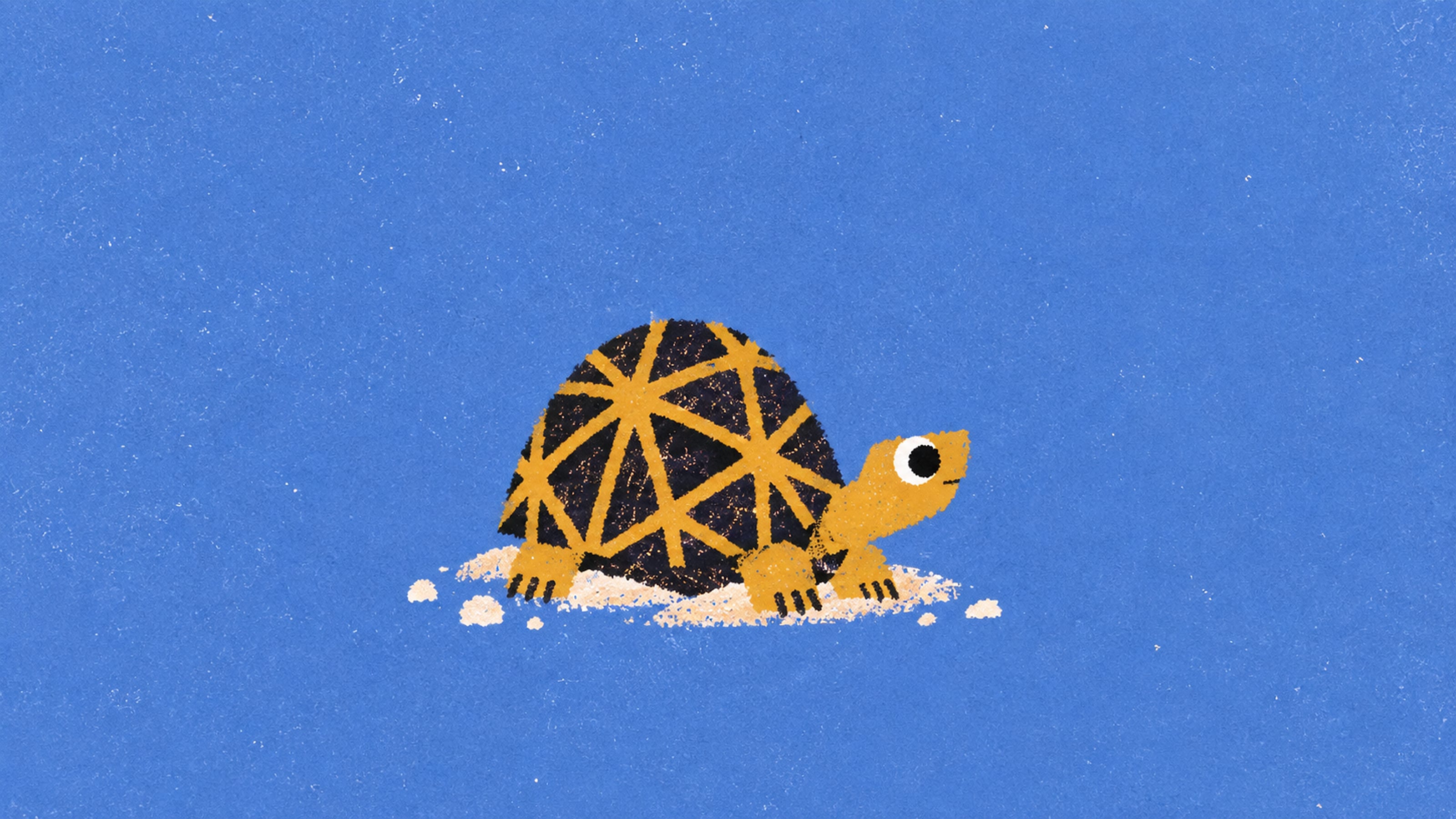
Northern Spider Tortoise (Pyxis arachnoides brygooi)
The Northern Spider Tortoise (Pyxis arachnoides brygooi) is a tortoise found in coastal southwestern Madagascar, listed Critically Endangered on the IUCN Red List.
- Common name
- Northern Spider Tortoise
- Scientific name
- Pyxis arachnoides brygooi
- Conservation status (IUCN Red List)
- Critically Endangered
- Habitat
- Coastal southwestern Madagascar
- Edition
- TT-28: The Web Weaver
The smallest spider tortoise, and the only one with no hinge in its belly shell. Critically Endangered in southwestern Madagascar.
Fast facts
- What it eats
- Plant eater: Young leaves, plus some bugs and whatever it finds. Like a salad with a few surprise crunchy bits.
- Where it lives
- Dry, thorny forest on sandy ground. Like a forest where every plant has spikes.
- Find it on the map
- Southwest Madagascar. A thin strip of coast in southwest Madagascar.
- The yellow lines on its shell look like a spider web drawn in gold marker. Like a shell with a web doodled on it.
- It is about four inches long. About the size of your hand.
- It lays one egg at a time, and that egg can take most of a year to hatch. Like waiting a whole school year for one chick.
- It rests underground for most of the dry season and comes out when the rains start. Like a kid who only comes outside when it rains.
It is Turtle Tuesday edition TT-28, “The Web Weaver”, drawn by hand and free to download.
Meet the smallest of the spider tortoises, about the size of your palm, wearing a shell that looks like someone drew a web on it in gold marker. Two of Madagascar’s three spider tortoises come with a trapdoor, a hinge in the belly shell that swings shut when trouble shows up. The northern spider tortoise doesn’t have one. No hinge, no door, no plan B. So it keeps a low profile instead, in the sandy spiny forest of the southwest, eating young leaves, insect larvae and, when the opportunity presents itself, the droppings of bigger animals. It lays one egg at a time. One. That egg can take the better part of a year to hatch. It’s Critically Endangered, pushed by habitat loss and a pet trade that treats a slow, one-egg animal like it can be replaced. It can’t.
The northern spider tortoise (Pyxis arachnoides brygooi) is the smallest of the three spider tortoise subspecies, averaging roughly 4.5 to 5 inches, and the only one with no hinged plastron. It lives only in the Mikea forest of southwestern Madagascar, eating young leaves, insect larvae and the droppings of larger animals. A female generally lays a single egg per clutch, incubating around 220 to 250 days. It’s Critically Endangered and on CITES Appendix I, and still smuggled despite the ban.
The Smallest Web, With No Door
The spider tortoise (Pyxis arachnoides) is found only in southwestern Madagascar, in spiny coastal vegetation. It’s named for the pale lines radiating across each dark scute, like a web drawn in gold. The northern subspecies, Pyxis arachnoides brygooi, is the smallest of three, averaging only about 4.5 to 5 inches.
What sets it apart is underneath. The other two subspecies have a hinged plastron, a trapdoor that closes the belly shell. The northern spider tortoise has no hinge; its plastron is rigid, so it relies instead on staying small, low and hard to find.
It lives in the Mikea forest from Monrobe to north of Tulear, split into three populations, an opportunistic grazer on young leaves, insect larvae and droppings. A female generally lays a single egg per clutch, incubating around 220 to 250 days, and it’s believed to live up to 70 years.
That slow pace makes every tortoise count. It’s Critically Endangered and on CITES Appendix I, and its forest needs protecting from clearing and from collectors for the pet trade.
Key Moments
- Southwestern Madagascar: The spider tortoise settles into the spiny vegetation of sandy coastal areas, the only place on Earth it lives
- Monrobe to Tulear: The northern subspecies holds a small range in the Mikea forest, split into three populations
- 2003 to 2011: A study measures a mean population decline of 10.8% as vegetation loss continues in the heart of its range
- 2020: Assessed as Critically Endangered on the IUCN Red List
- Present day: Protected under CITES Appendix I and by Madagascar law
Fun Facts
- A web on its back. Pale lines spread across each dark plate of its shell, like a web drawn in gold.
- No trapdoor. Its two cousins can close up their bottom shells like a door. This one has no hinge at all.
- Palm-sized. It is the smallest spider tortoise, only about 5 inches long.
- One egg at a time. A mother lays just one egg at a time, and it takes seven or eight months to hatch.
- Not a picky eater. It eats young leaves, insect grubs and even the droppings of bigger animals.
- Up to 70 years. It may live 70 years. That is plenty of time to finish its greens.
Conservation Notes
- The spider tortoise is Critically Endangered and on CITES Appendix I, banning international commercial trade. Collecting it is illegal in Madagascar.
- The northern subspecies lives in a small range in the Mikea forest, split into three populations. A study measured a mean decline of 10.8% between 2003 and 2011; a single-egg species recovers from that very slowly.
- A 2010 survey found northern spider tortoises in just three separate pockets of Madagascar’s Mikea forests, about 500 square kilometers in all.
Mini FAQ
What is the trapdoor, and why doesn’t this one have it?
Two of the three subspecies have a hinged plastron that closes the belly shell. The northern spider tortoise’s plastron has no hinge, so it depends instead on being small, staying low in the leaf litter, and not being found in the first place.
Why does laying one egg matter so much?
It sets the speed limit on recovery. A female generally lays a single egg per clutch, and it incubates around 220 to 250 days. A species that reproduces that slowly can’t bounce back from poaching, smuggling or habitat loss the way a fast-breeding animal can.
What helps it most?
Its forest, and being left in it. Trade is already illegal in Madagascar, so protecting the spiny forest and keeping collectors out do the most good.
Art by Lee Eisenbarth, CC BY 4.0: how to use this art.
Sources: IUCN Red List, Wikipedia.