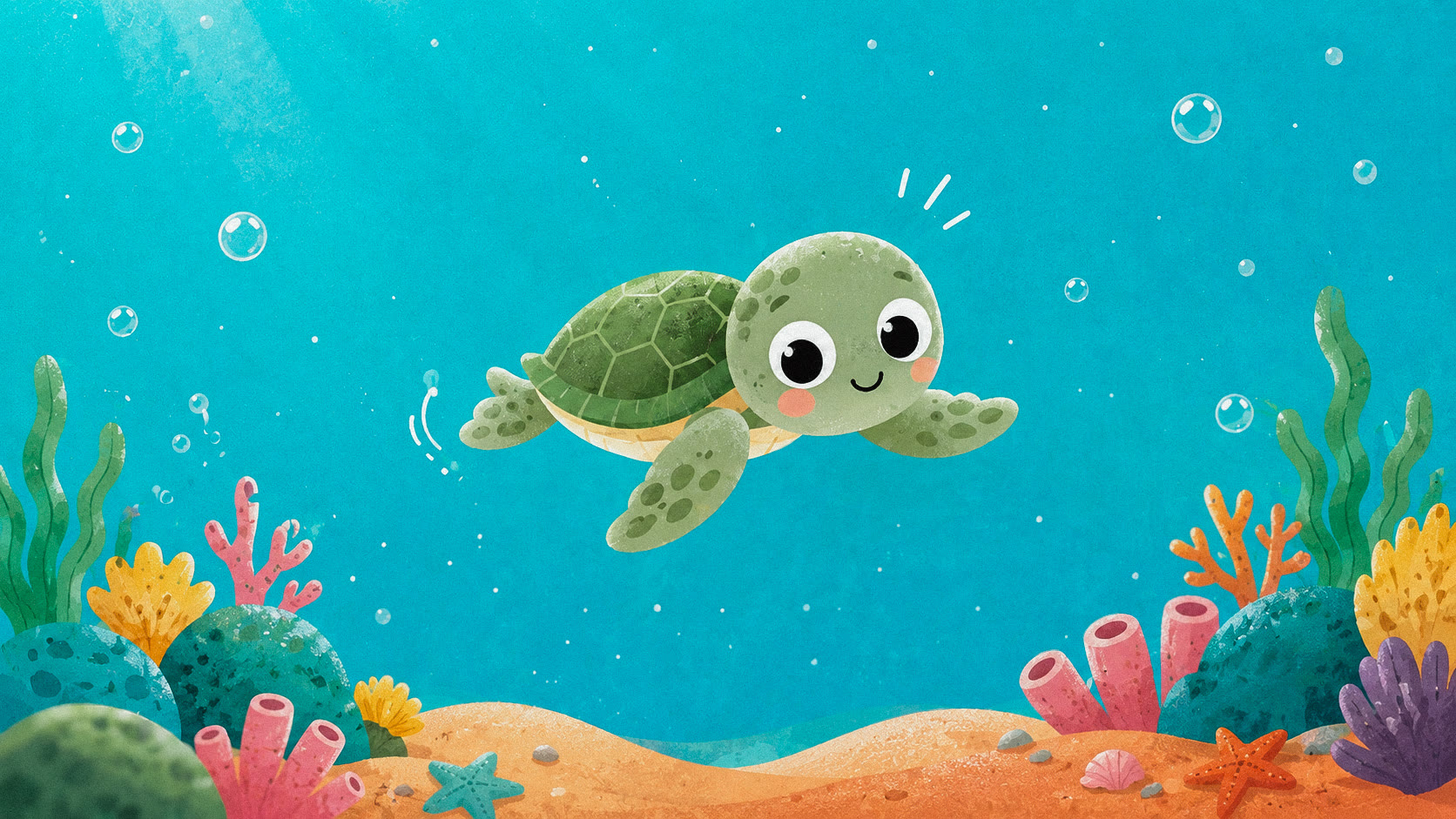
Olive Ridley Sea Turtle (Lepidochelys olivacea)
The Olive Ridley Sea Turtle (Lepidochelys olivacea) is a sea turtle found in tropical regions worldwide, listed Vulnerable on the IUCN Red List.
- Common name
- Olive Ridley Sea Turtle
- Scientific name
- Lepidochelys olivacea
- Conservation status (IUCN Red List)
- Vulnerable
- Habitat
- Tropical regions worldwide
- Edition
- TT-12: Flash Mob
Participates in the arribada: synchronized mass nesting events of up to 500,000 individuals over a few days.
It is Turtle Tuesday edition TT-12, “Flash Mob”, drawn by hand and free to download.
This drawing is one of the 26 in Color the Shell, the Turtle Tuesday turtle coloring book: the same line art in black and white, with one true fact per turtle.
Nobody sent invites. Nobody made a group chat. And yet, on one moonlit night, hundreds of thousands of olive ridley females just showed up. Same beach, same hour, shoulder to shoulder, flipping sand like they’re all late to the same party. It’s the biggest, most unexplained flash mob in nature, and scientists still can’t crack the code. Wind? Moon phase? Pheromones? Vibes? The Turtle Tuesday Club officially recognizes the arribada as the ultimate 'you had to be there’ moment: half a million strong, zero RSVPs, one perfect night.
The arribada, Spanish for ‘arrival,’ is a mass nesting event unique to ridley sea turtles. A single arribada at Ostional, Costa Rica has been documented at roughly 500,000 individuals over a few days. The trigger remains one of marine biology’s open questions: offshore wind, lunar cycling, and waterborne pheromones are the leading hypotheses. Despite being the most abundant sea turtle species, roughly 800,000 nesting females worldwide, their concentrated nesting makes them acutely vulnerable to bycatch, poaching, and habitat loss.
The Ocean’s Greatest Flash Mob
'Arribada’ means 'arrival’ in Spanish. But calling what olive ridleys do an 'arrival’ is like calling a stadium concert ‘a few people hanging out.’ Hundreds of thousands of female olive ridleys converge on the same beach within days, nesting shoulder to shoulder. Ostional, Costa Rica, recorded an estimated 500,000 turtles in a single event.
Scientists still don’t fully understand the synchronization. Leading hypotheses: offshore wind patterns, lunar cycles, and waterborne pheromones from the first females to arrive.
Olive ridleys are the most abundant sea turtle on Earth, with an estimated 800,000 nesting females worldwide. But abundance isn’t safety: a single fishing fleet or beach development project can impact tens of thousands at once.
In India, the beaches of Gahirmatha in Odisha host the world’s largest known rookery, hundreds of thousands arriving each year between January and March.
Key Moments
- 1880s: European naturalists first document mass nesting events in Central America
- 1960s to 1970s: Commercial harvest peaks in Mexico and Ecuador
- 1975: Mexico bans commercial harvest of sea turtles
- 1990s: Ostional, Costa Rica establishes a managed egg harvest program
- 2000s to now: Satellite tracking reveals complex offshore migration patterns
Fun Facts
- Flash Mob Nesting: Up to 500,000 females on one beach in a single arribada
- Moonlit Coordination: Arribadas often peak during the last quarter moon
- Named for Color: Named for the greenish-olive color of their heart-shaped carapace
- Ocean Nomads: Spend most of their lives in open ocean, coming ashore only to nest
- Compact Build: One of the smallest sea turtles at about 70 cm and 35 to 45 kg
- Egg Overload: A single arribada can leave millions of eggs on one beach in a few nights
Mini FAQ
How do hundreds of thousands of turtles all show up at once?
Nobody’s entirely sure. Leading theories: offshore wind, lunar cycles, waterborne pheromones.
Are olive ridleys the same as Kemp’s ridleys?
Close relatives in the same genus, but distinct species. Kemp’s ridleys are smaller, rarer, and nest almost exclusively in the Gulf of Mexico.
Why are they still vulnerable if they’re the most abundant sea turtle?
Concentrating in massive groups makes them uniquely vulnerable to bycatch, development, and pollution.
Art by Lee Eisenbarth, CC BY 4.0: how to use this art.
Sources: IUCN Red List, Wikipedia.