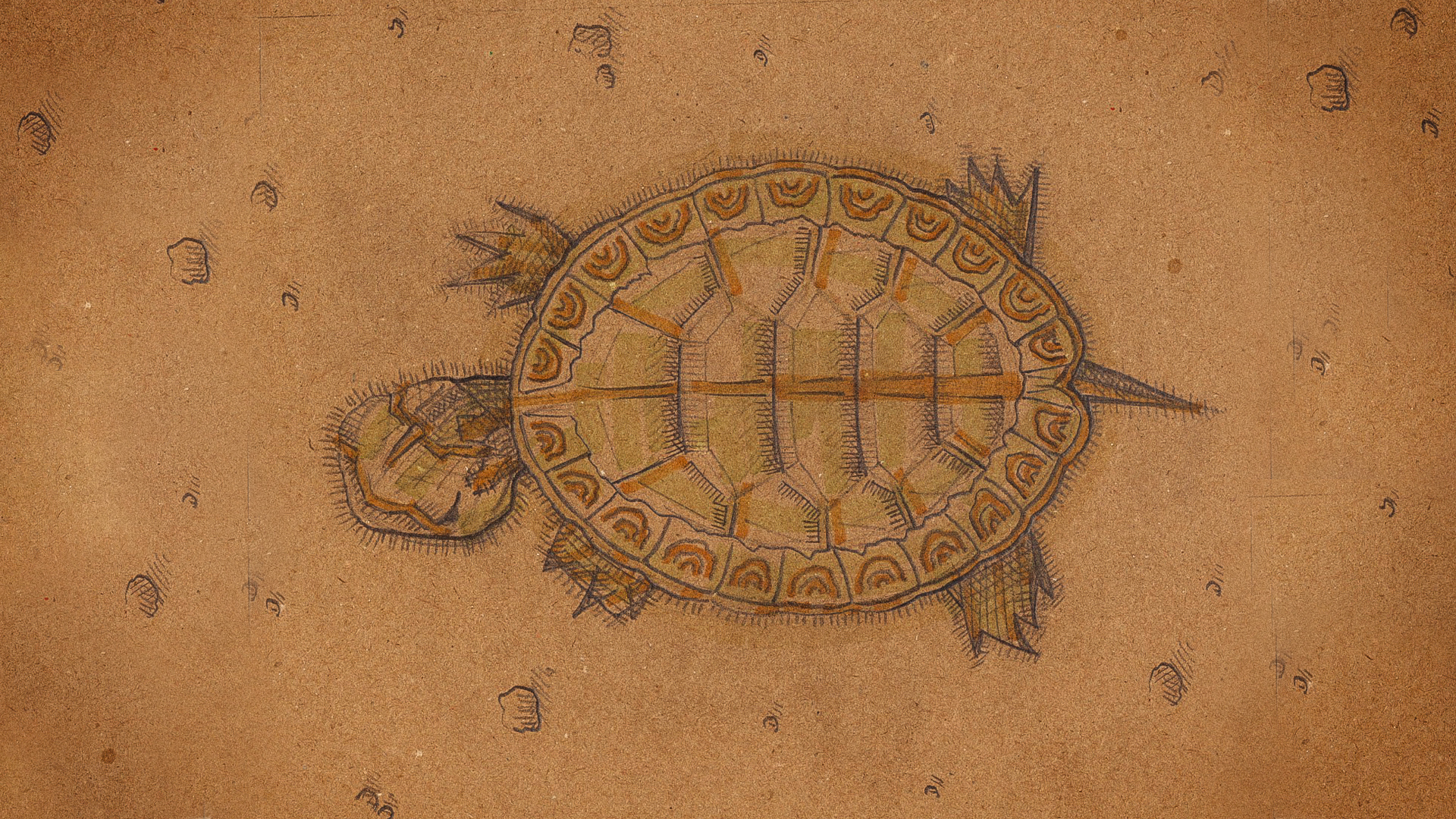
Painted Turtle (Chrysemys picta)
The Painted Turtle (Chrysemys picta) is a freshwater turtle found in ponds, marshes and streams across North America, listed Least Concern on the IUCN Red List.
- Common name
- Painted Turtle
- Scientific name
- Chrysemys picta
- Conservation status (IUCN Red List)
- Least Concern
- Habitat
- Ponds, marshes & streams across North America
- Edition
- TT-11: Main Character
Vivid red and yellow streaks on dark skin. Their hatchlings can survive being frozen solid through winter, thawing out in spring unharmed.
It is Turtle Tuesday edition TT-11, “Main Character”, drawn by hand and free to download.
This drawing is one of the 26 in Color the Shell, the Turtle Tuesday turtle coloring book: the same line art in black and white, with one true fact per turtle.
The painted turtle is North America’s most widespread native turtle, a basking icon found from coast to coast. With shell markings that look like brushstrokes, painted turtles are proof nature was the first artist. Their hatchlings can survive being frozen solid through winter, producing natural antifreeze and thawing out in spring like nothing happened. This week’s illustration by guest artist Brian White trades his potter’s wheel for a No. 2 Ticonderoga and Copic markers on Kraft card stock, sketching that painted-on beauty by hand.
Painted turtles are walking art galleries, and the most widespread native turtle in North America. Their babies can survive being frozen solid: hatchlings endure temperatures well below freezing, producing a kind of natural antifreeze, then thaw out in spring and just carry on.
North America’s Living Brushstroke
The painted turtle (Chrysemys picta) is the most widespread native turtle in North America, found in every US state except Hawaii, with four subspecies sharing the same red-and-yellow-streaked look.
Early European naturalists saw those bright shell margins and called them ‘painted.’ No other North American turtle looks like them; they’re unmistakable basking on a log, sometimes stacked three or four deep.
Their cold tolerance sets them apart. Hatchlings overwintering in the nest produce glucose-based cryoprotectants, natural antifreeze, that stop ice crystals from destroying cells. They can freeze solid, with no heartbeat and no brain activity, then thaw out in spring and walk away.
Painted turtles are the state reptile of Vermont, Michigan, Colorado, and Illinois. But their abundance doesn’t mean invulnerability: road mortality and nest predation by raccoons and skunks are persistent threats.
Key Moments
- 1783: Johann Gottlob Schneider formally describes Chrysemys picta
- 1931: Four subspecies recognized: Eastern, Midland, Western, Southern
- 1980s to 1990s: Landmark research reveals the cryoprotectant mechanism behind freeze tolerance
- 1995: Designated state reptile of Vermont, later Michigan, Colorado, and Illinois
- 2014: Genome of the Western painted turtle sequenced
Fun Facts
- Living Paintbrush: Vivid red and yellow streaks on dark olive skin
- Freeze Survivor: Hatchlings produce natural antifreeze and can survive being frozen solid
- Champion Baskers: Bask communally on logs, often stacking three or four deep
- Coast to Coast: Found in every US state except Hawaii
- Omnivore Menu: Eats aquatic plants, insects, crayfish, snails, and small fish
- State Reptile: Official state reptile of Vermont, Michigan, Colorado, and Illinois
Conservation Notes
- Roads are the biggest hazard for adults, so crossing signs and seasonal road barriers really help.
- Nest predation by raccoons and skunks can exceed 90% in some areas. Predator-exclusion cages dramatically improve hatchling survival.
- Climate change is shifting sex ratios: like many reptiles, their sex is set by nest temperature, and warmer nests produce more females.
- Canada’s 2018 national assessment found that more than 10,000 adult midland painted turtles likely live in the country.
Mini FAQ
How do painted turtles survive freezing?
Glucose-based cryoprotectants stop ice crystals from destroying cells; they freeze solid, then thaw unharmed.
Why do they stack on top of each other?
Basking matters for thermoregulation and shell health, so when log space is limited, they pile up.
Are painted turtles endangered?
No, they’re Least Concern. But road mortality and nest predation remain real threats.
How long do painted turtles live?
Typically 20 to 40 years in the wild, some past 50.
Can I keep a painted turtle as a pet?
Captive-bred ones are legal in many states; collecting wild ones usually isn’t. They’re a 30+ year commitment.
Art by Brian White, CC BY 4.0: how to use this art.
Sources: IUCN Red List, Wikipedia.