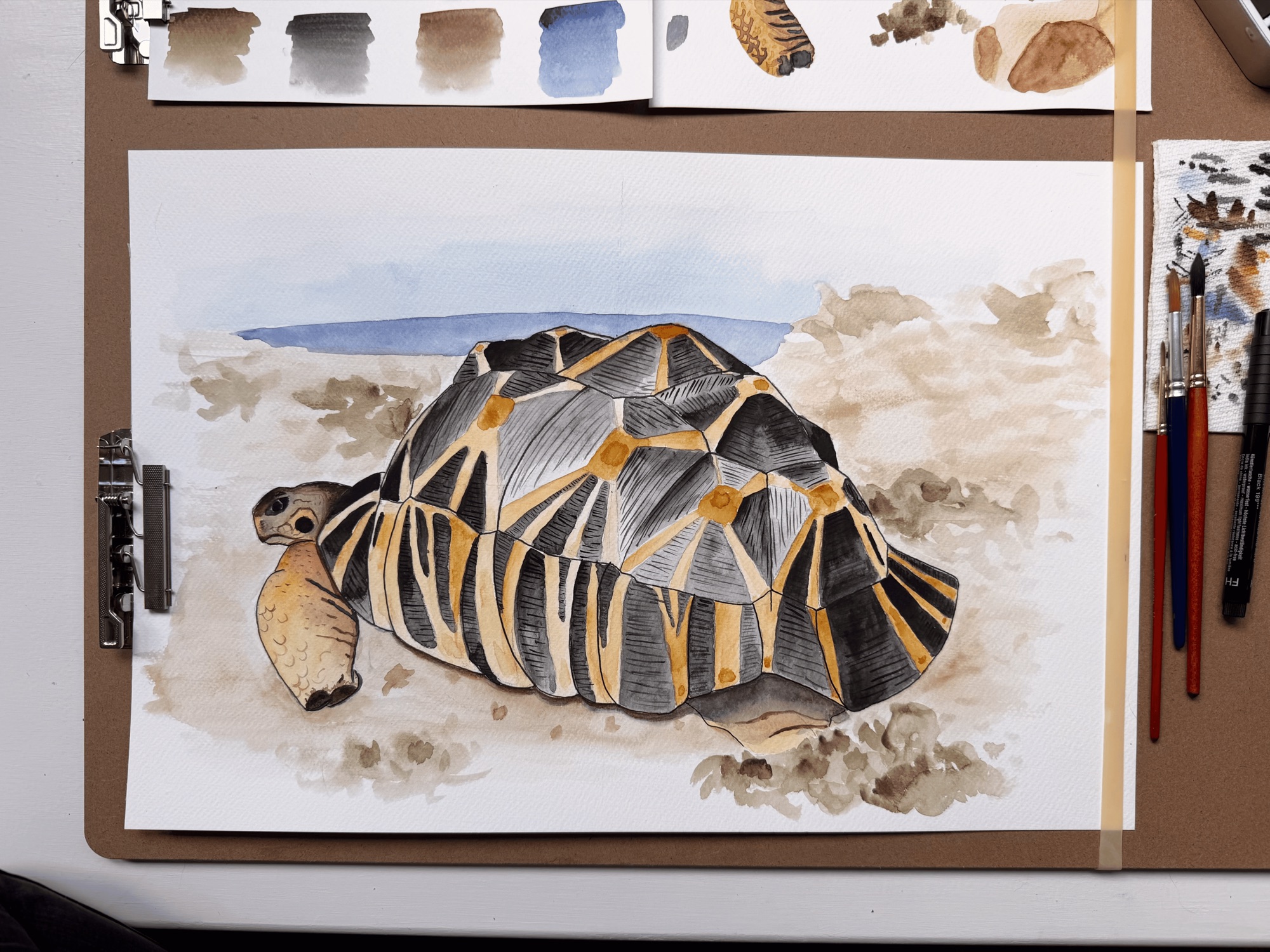
Radiated Tortoise (Astrochelys radiata)
The Radiated Tortoise (Astrochelys radiata) is a tortoise found in southern and southwestern Madagascar, listed Critically Endangered on the IUCN Red List.
- Common name
- Radiated Tortoise
- Scientific name
- Astrochelys radiata
- Conservation status (IUCN Red List)
- Critically Endangered
- Habitat
- Southern & southwestern Madagascar
- Edition
- TT-18: Living Starburst
One of the most beautiful tortoises on Earth, a Madagascar endemic with brilliant yellow starbursts radiating from each scute.
It is Turtle Tuesday edition TT-18, “Living Starburst”, drawn by hand and free to download.
This drawing is one of the 26 in Color the Shell, the Turtle Tuesday turtle coloring book: the same line art in black and white, with one true fact per turtle.
Meet Sybil. She is roughly the age of your grandmother and arguably wiser, because radiated tortoises routinely cruise past 100. The most famous one, Tu’i Malila, made it to about 188. Every golden line on Sybil’s shell radiates from a single point like a tiny sunrise, which is excellent camouflage in Madagascar’s spiny scrub and, frankly, just objectively gorgeous. She grazes on grass, fruit, and the occasional cactus pad, naps with tremendous commitment, and is in no hurry to be anywhere you’d like her to be. Sybil would like you to know that being this beautiful is a full-time job, and that she is, in fact, Critically Endangered, so admire from a respectful, poacher-free distance.
The radiated tortoise is one of the most beautiful tortoises on Earth. Each dark scute is etched with yellow lines radiating from a central point, the pattern that names the species. It lives only in the spiny forests and dry scrub of southern Madagascar, and many pass 100 years; Tu’i Malila is thought to have reached about 188. But their beauty is also their curse. Prized by the illegal pet trade and hunted for meat, radiated tortoises are now Critically Endangered. Nature’s masterpiece, paying a heavy price for being a masterpiece.
Madagascar’s Walking Masterpiece
The radiated tortoise (Astrochelys radiata) is endemic to Madagascar, found only in the spiny forests and scrub of the island’s far south and southwest. Each scute on its tall, dark shell carries a starburst of fine yellow lines, and no two shells are quite identical.
Adults reach roughly 40 centimeters of shell length and around 16 kilograms. The radiating markings help camouflage them in the broken light of the spiny forest, surprisingly effective for an animal that otherwise looks like a walking centerpiece. They browse on grasses, fallen fruit, and succulents, revisiting patches to keep fresh growth coming.
They routinely live well past a century: Tu’i Malila, reportedly gifted to the Tongan royal family by Captain James Cook in the late 1770s, lived until 1965, an estimated age of around 188.
The IUCN lists the radiated tortoise as Critically Endangered. Its dazzling shell draws collectors and its spiny forest is being cleared, so conservationists and local communities are working to keep both safe.
Key Moments
- Late 1770s: Tu’i Malila, a radiated tortoise later said to have been gifted to the Tongan royal family by Captain James Cook, begins one of the longest documented animal lifespans on record
- 1802: English naturalist George Shaw formally describes the species; the radiating pattern gives it the name radiata
- 1965: Tu’i Malila, a radiated tortoise in Tonga, reaches an estimated age of around 188, one of the longest lives on record
- 2008: The IUCN lists the species as Critically Endangered, putting it at the top of conservation’s list
- 2018: Authorities discover roughly 10,000 radiated tortoises crammed into a single home in Toliara, Madagascar
Fun Facts
- Living Starburst: Each dark scute is etched with fine yellow lines radiating from a central point, naming the species
- Madagascar Only: It lives nowhere else on Earth but the spiny forests and dry scrub of southern Madagascar
- Older Than the USA’s Grandparents: Routinely lives past 100; the famous Tu’i Malila reached an estimated ~188 years
- Committed Grazer: A dedicated herbivore that revisits patches of grasses, fruit, and succulents
- Hidden in Plain Sight: Those bold markings break up its outline in dappled forest light
- Protected by Tradition: Local fady, or taboos, in southern Madagascar have long forbidden harming it
Conservation Notes
- The radiated tortoise’s beauty is its biggest problem and the reason so many people protect it. In 2018 about 10,000 were rescued from a single home and cared for by conservationists.
- Confined to the spiny forests of southern Madagascar, the species is also squeezed by habitat loss from charcoal and agriculture; groups now run confiscation and breeding programs.
- The radiated tortoise’s core home, the spiny forest of southern Madagascar, covers only about 10,000 square kilometers, its 2008 Red List assessment found.
Mini FAQ
Why is it called a 'radiated’ tortoise?
Because of the shell. Every dark, domed scute is marked with yellow lines spreading outward from a pale central spot, like rays from a sun.
How long do they actually live?
A very long time. Many live well past 100; Tu’i Malila, reportedly gifted to the Tongan royal family in the late 1700s, lived until 1965, an estimated age of about 188. Slow and steady, taken to its logical extreme.
Why are they Critically Endangered?
Mostly because they’re gorgeous and live in one place. That shell draws collectors, and their spiny forest is being cleared for charcoal and farmland.
Art by Danni Kane, CC BY 4.0: how to use this art.
Sources: IUCN Red List, Wikipedia.