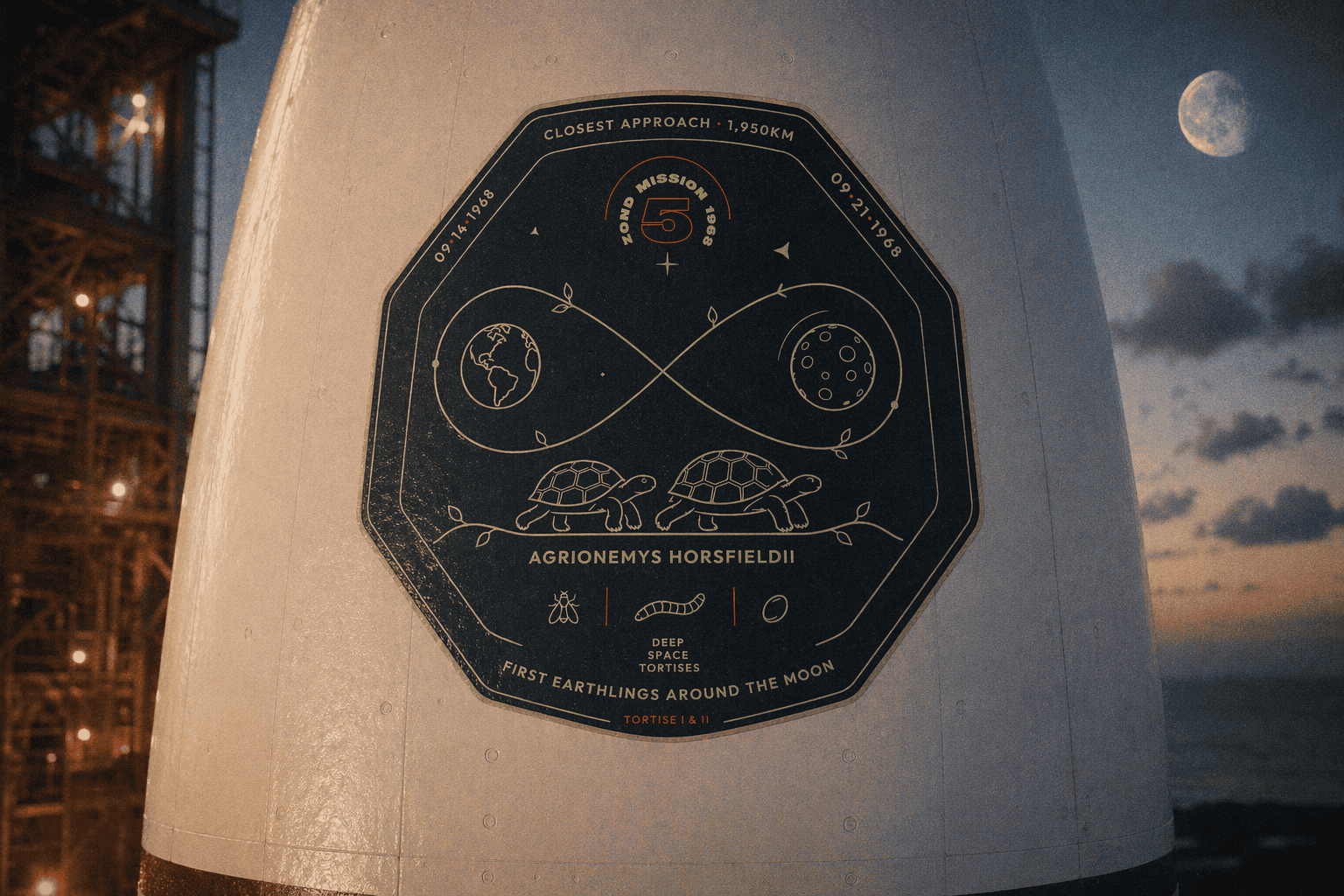
Russian Tortoise (Agrionemys (Testudo) horsfieldii)
The Russian Tortoise (Agrionemys (Testudo) horsfieldii) is a tortoise found in Central Asian steppes and deserts, listed Vulnerable on the IUCN Red List.
- Common name
- Russian Tortoise
- Scientific name
- Agrionemys (Testudo) horsfieldii
- Conservation status (IUCN Red List)
- Vulnerable
- Habitat
- Central Asian steppes & deserts
- Edition
- TT-09: Moon Loop
The first Earth creatures to travel around the Moon and return home alive in 1968, months before Apollo 8.
It is Turtle Tuesday edition TT-09, “Moon Loop”, drawn by hand and free to download.
This drawing is one of the 26 in Color the Shell, the Turtle Tuesday turtle coloring book: the same line art in black and white, with one true fact per turtle.
Went to space before any human. Looped the Moon before any human. Came home alive before any human. Didn’t make a big deal about it. Two small steppe tortoises quietly holding the greatest flex in the animal kingdom and never once bringing it up.
On September 14, 1968, the Soviet Union launched Zond 5 from Baikonur Cosmodrome carrying two Russian tortoises, fruit fly eggs, plants, and bacteria. The spacecraft swung past the Moon at 1,950 kilometers from the surface, looped around, and splashed down in the Indian Ocean seven days later. The tortoises were alive and had lost only minor body weight. They became the first Earth creatures to travel around the Moon and return home, months before Apollo 8 carried humans on the same journey.
Astro-Tortoises
In September 1968, the Soviet Union launched Zond 5 on a daring test flight around the Moon. On board: two Russian tortoises, fruit fly eggs, worms, plants, algae, and bacteria, basically a very cramped science fair in orbit.
Zond 5 flew past the Moon, looped around, and splashed down in the Indian Ocean. The tortoises came back alive, the first animals to travel to the Moon’s neighborhood and return.
By the end of 1968, Apollo 8’s human crew followed a similar path, but the tortoises had already quietly claimed the “first around the Moon and back” trophy.
Why tortoises? Scientists needed animals that could handle long, stressful trips and fit in a small capsule.
Mission Timeline
- September 14, 1968: Zond 5 launches from Baikonur Cosmodrome
- September 18, 1968: Spacecraft swings past the Moon, ~1,950 km from the surface
- September 21, 1968: Zond 5 splashes down in the Indian Ocean; tortoises alive and well
- Late 1968: News spreads: the first Earth creatures around the Moon were small steppe tortoises
Fun Facts
- First Around the Moon: Two Russian tortoises on Zond 5, 1968
- Not Sea Turtles: Land tortoises from Central Asia. Imagine sending a desert reptile on the ultimate boat ride
- Space Roommates: Shared the ship with fruit fly eggs, worms, seeds, algae, and bacteria
- Moon Loop, No Landing: Flew past and looped back, no moonwalk
- Watched From Earth: NASA tracked Zond 5 live, curious what it meant for the Moon race
- Tortoise > Space Race Ego: Humans on Apollo 8 did it months later
On the Red List
- Where the steppe suits it, it’s plentiful: a four-year study in Kazakhstan, published in 1988, counted up to 15 Russian tortoises per hectare.
Mini FAQ
Did the tortoises wear tiny space suits?
No suits. They stayed inside the pressurized capsule, their own shell doing double duty.
Did they walk on the Moon?
They flew around it on a looping path and came straight back.
Why not use monkeys or dogs again?
Scientists needed hardy animals that could handle long stretches with limited resources.
Art by Lee Eisenbarth, CC BY 4.0: how to use this art.
Sources: IUCN Red List, Wikipedia.