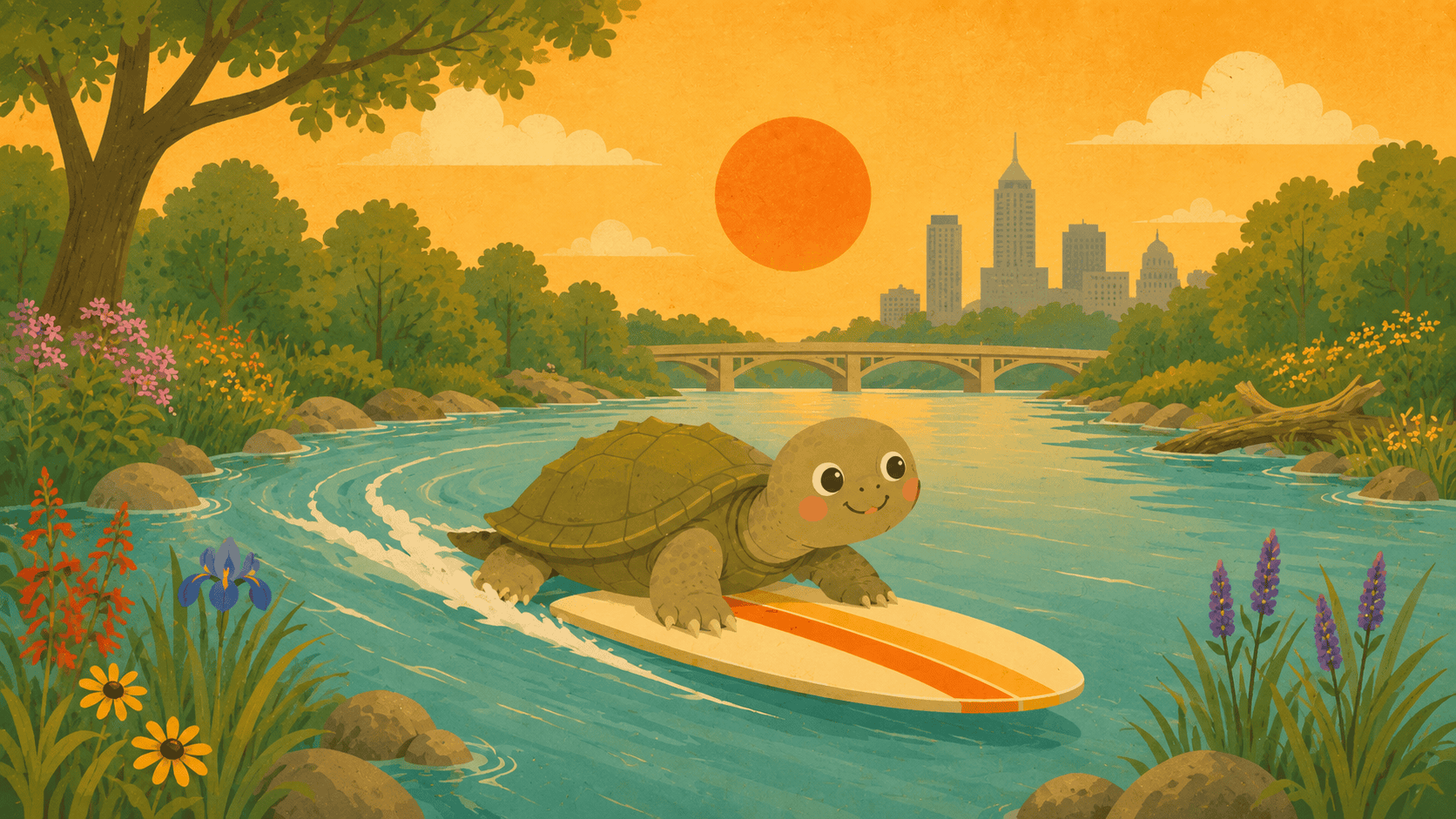
Snapping Turtle (Chelydra serpentina)
The Snapping Turtle (Chelydra serpentina) is a freshwater turtle found in lakes, rivers and swamps, eastern North America, listed Least Concern on the IUCN Red List.
- Common name
- Snapping Turtle
- Scientific name
- Chelydra serpentina
- Conservation status (IUCN Red List)
- Least Concern
- Habitat
- Lakes, rivers & swamps, eastern North America
- Edition
- TT-13: No Nonsense
Virtually unchanged for 40 million years. Can't retract into its shell, so it evolved a legendary bite force instead.
It is Turtle Tuesday edition TT-13, “No Nonsense”, drawn by hand and free to download.
This drawing is one of the 26 in Color the Shell, the Turtle Tuesday turtle coloring book: the same line art in black and white, with one true fact per turtle.
Common snapping turtles are absolute tanks. They can’t retract into their shells (the plastron is too small), so instead of hiding, they bite. Hard. In the water they’re docile, almost shy. It’s only on land that they get defensive, because on land they’re vulnerable and they know it. They’ve been doing this for 40 million years with almost no changes. When you’re already perfectly designed, why fix what isn’t broken? Absolute respect.
Common snapping turtles are absolute tanks. They can’t retract into their shells (the plastron is too small), so instead of hiding, they bite. Hard. In the water they’re docile, almost shy. It’s only on land that they get defensive, because on land they’re vulnerable and they know it. They’ve been doing this for 40 million years with almost no changes. When you’re already perfectly designed, why fix what isn’t broken? Absolute respect.
40 Million Years of No Chill
The common snapping turtle (Chelydra serpentina) has barely changed in 40 million years, predating the Great Lakes and most modern mammals.
Snappers can’t retract into their shell. The plastron, the bottom plate, is a reduced sliver that leaves their legs and neck exposed. So they evolved one of the most powerful bites in the freshwater world instead. On land they’re vulnerable, and they know it, so that’s where they get aggressive. In the water, where they can escape easily, they’re surprisingly docile.
They live in nearly every freshwater habitat east of the Rockies, from southern Canada to the Gulf of Mexico. Ponds, lakes, rivers, swamps, drainage ditches: if it holds water, there’s probably a snapper in it. They’re apex predators in most of them, eating fish, frogs, snakes, birds, small mammals, other turtles, and plants. Opportunistic doesn’t begin to cover it.
Snapping turtles face real pressure from road mortality during nesting season, when females travel overland to find nesting sites. Because they take 15 to 20 years to mature and can live past 50, every adult female lost is a serious hit.
Key Moments
- ~40 million years ago: Fossil snapping turtles appear, nearly identical to modern forms
- 1700s to 1800s: Widely harvested as a colonial-era food
- 1950s to 1970s: Commercial harvest peaks; states begin size limits
- 2000s to now: Road studies flag nesting-season mortality as a top concern
Fun Facts
- Can’t Hide, Won’t Hide: Plastron too small to retract into, so they bite instead
- Docile Underwater: Calm in water, even shy. Aggression is a land-only strategy
- Living Fossil: Unchanged for 40 million years, older than the Rockies
- Eats Everything: Fish, frogs, snakes, birds, mammals, plants, other turtles: a true omnivore
- Ice Swimmer: Active under ice in winter, walking lake bottoms in near-freezing water
- Long Walk to the Nest: Females travel overland, sometimes far from water, to find the perfect sandy spot to nest
On the Red List
- Male snapping turtles take 15 to 20 years to grow up, Canada’s 2008 status report found, which is why protecting adults matters so much.
Mini FAQ
How strong is the bite?
About 209 Newtons, strong enough to break a broomstick but weaker than their reputation suggests. The real danger is speed: they strike faster than a human can react.
Are they dangerous to swimmers?
Essentially no. In water they swim away. Almost every bite happens on land, when someone handles or corners one that can’t retreat.
What should I do if one is crossing the road?
Help it across in the direction it was heading. Pick it up by the rear of the shell (never the tail, which can injure the spine), or slide it onto a car mat. It will try to bite, so keep your hands away from the front half.
Art by Lee Eisenbarth, CC BY 4.0: how to use this art.
Sources: IUCN Red List, Wikipedia.