Speckled Cape Tortoise (Chersobius signatus)
The Speckled Cape Tortoise (Chersobius signatus) is a tortoise found in Namaqualand, Northern Cape, South Africa, listed Endangered on the IUCN Red List.
- Common name
- Speckled Cape Tortoise
- Scientific name
- Chersobius signatus
- Conservation status (IUCN Red List)
- Endangered
- Habitat
- Namaqualand, Northern Cape, South Africa
- Edition
- TT-17: Pocket Tank
The world's smallest tortoise: a thumb-sized, black-speckled dweller of South Africa's Namaqualand that hides from predators and heat inside narrow rock cracks.
It is Turtle Tuesday edition TT-17, “Pocket Tank”, drawn by hand and free to download.
This drawing is one of the 26 in Color the Shell, the Turtle Tuesday turtle coloring book: the same line art in black and white, with one true fact per turtle.
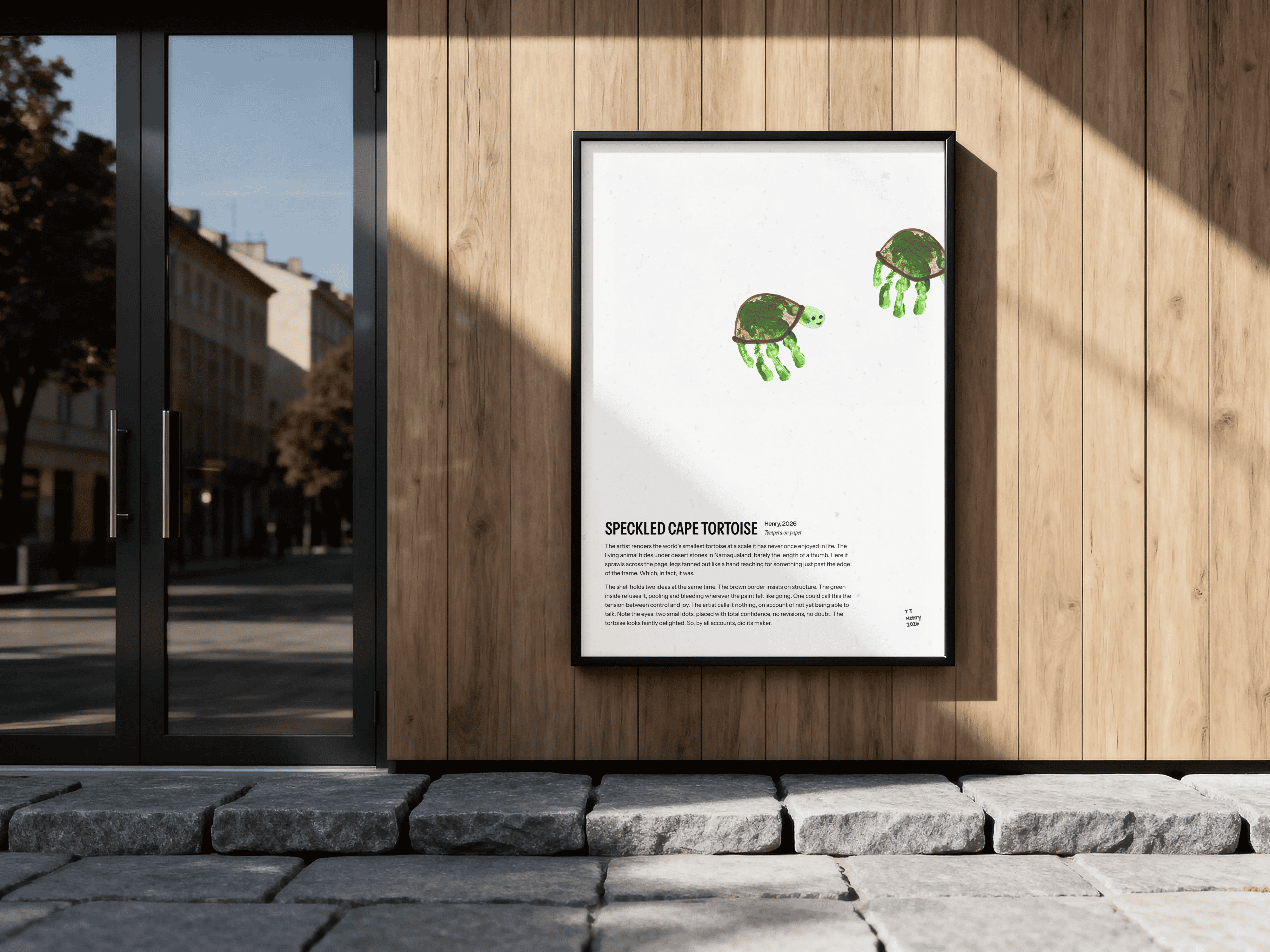
The artist renders the world’s smallest tortoise at a scale it has never once enjoyed in life. The living animal hides under desert stones in Namaqualand, barely the length of a thumb. Here it sprawls across the page, legs fanned out like a hand reaching past the edge of the frame, which, in fact, it was. The brown border insists on structure; the green inside refuses it, pooling and bleeding wherever the paint felt like going. One could call this the tension between control and joy. The artist calls it nothing, on account of not yet being able to talk. Note the eyes: two dots, placed with total confidence, no revisions, no doubt. The tortoise looks faintly delighted. So, by all accounts, did its maker.
The speckled Cape tortoise is the smallest tortoise, and the smallest turtle of any kind, on Earth. A grown male is about the length of a thumb, six to eight centimeters. It lives nowhere else but Namaqualand, in South Africa’s Northern Cape and barely into southern Namibia. Its tan, salmon and orange-brown shell is scattered with fine black speckles, which is where the name comes from. When a crow swings overhead or the heat turns punishing, it wedges itself sideways into a rock crack.
The Smallest Tortoise Alive
The speckled Cape tortoise (Chersobius signatus) holds a singular record: the smallest tortoise, and smallest turtle of any kind, in the world. An adult male measures six to eight centimeters, about the length of a thumb, and weighs around 95 to 165 grams; females reach about ten centimeters.
It lives in just one place: Namaqualand, a narrow, arid strip of the Northern Cape that barely reaches into southern Namibia, part of the Succulent Karoo biome. Its shell is flat and lightweight by design: when a predator appears or the sun turns punishing, it wedges sideways into a rock crevice too narrow for most predators.
In the cool morning it emerges to graze on tiny succulents and flowers, then retreats into rock shade for the heat of the day. A female usually lays just a single egg at a time, among the smallest clutches of any tortoise on Earth.
For most of its history the species sat in the genus Homopus, but a 2017 revision moved it into Chersobius. The IUCN lists it as Endangered, its tiny range vulnerable to illegal collection, overgrazing, bird predation, and a drying climate.
Key Moments
- 1792: German naturalist Johann Gottlob Schoepff describes the species as Testudo signata, meaning marked
- 20th century: Placed in the genus Homopus, the padlopers (Afrikaans for path walkers)
- Late 1900s to 2000s: Recognized as the smallest tortoise species in the world; its tiny range raises alarms
- 2017: A revision moves it into the resurrected genus Chersobius, its current name
- Present day: Listed by the IUCN as Endangered; the pet trade, overgrazing, and a drying climate are the threats
Fun Facts
- World’s Smallest: No tortoise or turtle on Earth is smaller; a grown male is about the length of a thumb
- Crack Dweller: Its flat shell lets it wedge sideways into rock crevices to escape predators and heat
- Born Speckled: Hundreds of fine black flecks scatter across its shell, the source of its name
- One and Done: A female usually lays just a single egg, among the smallest clutches of any tortoise
- Tiny Address: It lives nowhere else but Namaqualand, a slim arid strip reaching into Namibia
- Karoo Grazer: It grazes in the cool morning, sheltering in the rocks as the desert heats up
Conservation Notes
- With one of the smallest natural ranges of any tortoise, it has almost no buffer: habitat loss from overgrazing and mining, plus a drying climate, threatens it at once.
- Illegal collection for the pet trade is a persistent danger: its rarity and tiny size make it a target, even though it rarely survives long outside the Karoo.
- A five-year study in Namaqualand found 16 to 21 speckled tortoises living on each hectare, young and old together, the sign of a healthy population.
Mini FAQ
Just how small is the world’s smallest tortoise?
Genuinely pocket-sized. An adult male is six to eight centimeters, roughly the length of your thumb, and weighs around 95 to 165 grams.
Why does it live in rock cracks?
Survival. Its flat shell lets it squeeze sideways into narrow crevices, safe from crows and the brutal midday heat. The crack is both bunker and air-conditioning.
Why is it endangered?
Mostly because it has nowhere else to go. The whole species lives in one small, arid corner of southern Africa, so every pressure hits at once.
Art by Henry Thomas Eisenbarth, CC BY 4.0: how to use this art.
Sources: IUCN Red List, Wikipedia.