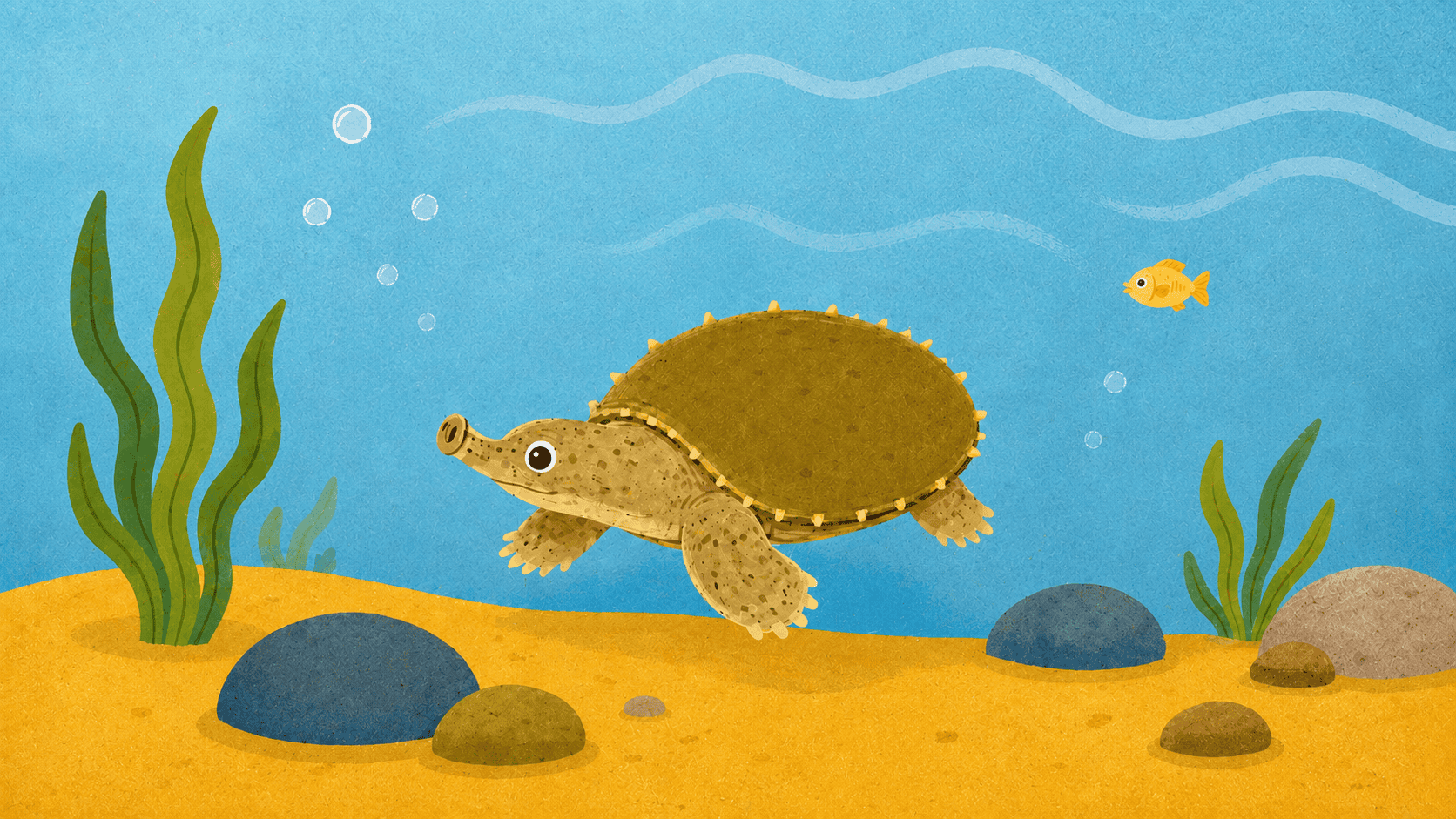
Spiny Softshell Turtle (Apalone spinifera)
The Spiny Softshell Turtle (Apalone spinifera) is a freshwater turtle found in rivers, lakes and streams across North America, listed Least Concern on the IUCN Red List.
- Common name
- Spiny Softshell Turtle
- Scientific name
- Apalone spinifera
- Conservation status (IUCN Red List)
- Least Concern
- Habitat
- Rivers, lakes & streams across North America
- Edition
- TT-16: River Pancake
Flat, leathery, pancake-shaped disc with a snorkel nose. Can absorb oxygen through its skin underwater.
It is Turtle Tuesday edition TT-16, “River Pancake”, drawn by hand and free to download.
This drawing is one of the 26 in Color the Shell, the Turtle Tuesday turtle coloring book: the same line art in black and white, with one true fact per turtle.
No hard shell, no bony armor. Just a flat, leathery, pancake-shaped disc with a ridiculously long snorkel nose. The spiny softshell buries itself in the sandy river bottom, leaves only the tip of its nose above the surface, and waits. It’s one of the fastest turtles alive, in water and on land, and it can pull oxygen straight from the water through its skin, staying submerged for hours. Soft doesn’t mean fragile. It means built for the current. North America’s leather pancake, fully optimized.
Spiny softshell turtles look like someone took a regular turtle and forgot to finish it. No hard shell, just a flat, leathery, pancake-shaped disc with a ridiculously long snorkel nose. They’re one of the fastest turtles alive, in water and on land. That nose works like a snorkel: they bury themselves in sandy river bottoms with just the tip poking above the surface. They can absorb oxygen through their skin and throat lining underwater, staying submerged for hours. Soft on the outside, absolute survival machine underneath.
Soft Shell, Hard to Catch
Instead of the rigid, scuted carapace most turtles wear, it has a flat, leathery disc covered in skin, shaped almost like a pancake. The 'spiny’ part of its name comes from small tubercles along the front edge, just behind the neck.
Its most distinctive feature is the long, tubular snout, tipped with nostrils that work like a snorkel. It buries itself in sand or mud, leaving just the tip of its nose above the surface. With a flexible neck and sharp beak, it’s a patient predator of fish, crayfish, and insects.
Spiny softshells absorb oxygen directly from the water through their skin and the vascularized lining of their throat, called pharyngeal respiration, letting them stay submerged for hours. Despite the flat, awkward build, they’re among the fastest turtles alive.
Spiny softshells range across the Mississippi, Missouri, and Ohio drainages and the Great Lakes. Females grow far larger than males; a grown female’s disc can span around 50 centimeters. The IUCN lists them as Least Concern.
Key Moments
- ~100+ million years ago: The softshell family, Trionychidae, appears in the Cretaceous fossil record
- 1827: Charles Alexandre Lesueur formally describes the species as Trionyx spiniferus, for its shell spines
- 1900s: Recognized across numerous subspecies spanning central North America
- 1980s to 1990s: Research confirms softshells use genetic sex determination, unlike most turtles
- 2000s to now: Cutaneous and pharyngeal respiration studied as the key to their marathon dives
Fun Facts
- Living Pancake: A flat, leathery, skin-covered shell with no hard scutes, shaped like a pancake
- Built-In Snorkel: A long tubular snout lets it breathe with only its nose tip above the surface
- Skin Breather: Absorbs oxygen straight from the water through its skin and throat lining
- Speed Demon: One of the fastest turtles alive, in water and on land
- Females Tower: Females grow far larger than males; a grown female’s disc can span around 50 cm
- Genes, Not Heat: Sex is determined by genetics, not nest temperature like most other turtles
Conservation Notes
- Though listed as Least Concern, spiny softshells depend on clean rivers with sandy bottoms for burying and nesting, habitats degraded by dams and sedimentation.
- Nesting females face road mortality and shoreline development; incidental capture on baited fishing lines remains a concern in parts of the range.
- Ontario’s government estimates at least 900 adult spiny softshells live in the province, in 12 local populations, mostly around Lake Erie.
Mini FAQ
Why is it called a ‘softshell’?
Because it genuinely is soft. Instead of the hard, scuted carapace most turtles have, its shell is a flexible, leathery disc covered in skin. 'Spiny’ refers to tubercles along the front edge.
How do they stay underwater for so long?
Two tricks: they absorb oxygen through their skin, and through their throat lining (pharyngeal respiration), letting them breathe without surfacing for hours.
Do they bite?
They can. Sharp beak, long neck that reaches surprisingly far back. They’re shy and usually flee, but a handled one will bite. Best policy: admire from a distance and let it disappear into the sand.
Art by Lee Eisenbarth, CC BY 4.0: how to use this art.
Sources: IUCN Red List, Wikipedia.